Advertisements
Advertisements
प्रश्न
Two chords AB and CD of lengths 5 cm 11cm respectively of a circle are parallel to each other and are on opposite sides of its centre. If the distance between AB and CD is 6 cm, find the radius of the circle.
Advertisements
उत्तर
Draw OM ⊥ AB and ON ⊥ CD. Join OB and OD.
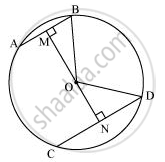
BM = AB/2 = 5/2 (Perpendicular from the centre bisects the chord)
ND = CD/2 = 11/2
Let ON be x. Therefore, OM will be 6− x.
In ΔMOB,
OM2 + MB2 = OB2
(6 - x)2 + (5/2)2 = OB2
36 + x2 - 12x + 25/4 = OB2 ........(1)
In ΔNOD,
ON2 + ND2 = OD2
x2 + (11/2)2 = OD2
x2 + 121/4 = OD2 .........(2)
We have OB = OD (Radii of the same circle)
Therefore, from equation (1) and (2),
`36+x^2-12x+25/4=x^2+121/4`
`12x=36+24/4-121/4`
`=(144+25-121)/4`
`=48/4`
= 12
x = 1
From equation (2),
`(1)^2+(121/4)=OD^2`
`OD^2 = 1+121/4=125/4`
`OD=5/2sqrt5`
Therefore, the radius of the circle is `5/2sqrt5" cm."`
संबंधित प्रश्न
If the non-parallel sides of a trapezium are equal, prove that it is cyclic.
Bisectors of angles A, B and C of a triangle ABC intersect its circumcircle at D, E and F respectively. Prove that the angles of the triangle DEF are 90°-A, 90° − `1/2 A, 90° − 1/2 B, 90° − 1/2` C.
ABCD is a cyclic quadrilateral in BC || AD, ∠ADC = 110° and ∠BAC = 50°. Find ∠DAC.
Circles are described on the sides of a triangle as diameters. Prove that the circles on any two sides intersect each other on the third side (or third side produced).
ABCD is a cyclic trapezium with AD || BC. If ∠B = 70°, determine other three angles of the trapezium.
Prove that the perpendicular bisectors of the sides of a cyclic quadrilateral are concurrent.
PQRS is a cyclic quadrilateral such that PR is a diameter of the circle. If ∠QPR = 67° and ∠SPR = 72°, then ∠QRS =
If a pair of opposite sides of a cyclic quadrilateral are equal, prove that its diagonals are also equal.
ABCD is a parallelogram. A circle through A, B is so drawn that it intersects AD at P and BC at Q. Prove that P, Q, C and D are concyclic.
The three angles of a quadrilateral are 100°, 60°, 70°. Find the fourth angle.
