Advertisements
Advertisements
प्रश्न
If P, Q and R are the mid-points of the sides BC, CA and AB of a triangle and AD is the perpendicular from A on BC, prove that P, Q, R and D are concyclic.
Advertisements
उत्तर
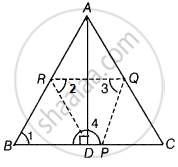
Given: In ΔABC, P, Q and R are the mid-points of the sides BC, CA and AB respectively. Also, AD ⊥ BC.
To prove: P, Q, R and D are concyclic.
Construction: Join DR, RQ and QP
Proof: In right-angled ΔADP, R is the mid-point of AB.
∴ RB = RD
⇒ ∠2 = ∠1 ...(i) [Angles opposite to the equal sides are equal]
Since, R and Q are the mid-points of AB and AC, then
RQ || BC ...[By mid-point theorem]
or RQ || BP
Since, QP || RB, then quadrilateral BPQR is a parallelogram.
⇒ ∠1 = ∠3 ...(ii) [Opposite angles of parallelogram are equal]
From equations (i) and (ii),
∠2 = ∠3
But ∠2 + ∠4 = 180° ...[Linear pair axiom]
∴ ∠3 + ∠4 = 180° ...[∴ ∠2 = ∠3]
Hence, quadrilateral PQRD is a cyclic quadrilateral.
So, points P, Q, R and D are non-cyclic.
Hence proved.
APPEARS IN
संबंधित प्रश्न
Prove that ‘Opposite angles of a cyclic quadrilateral are supplementary’.
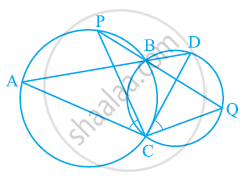
Two circles intersect at two points B and C. Through B, two line segments ABD and PBQ are drawn to intersect the circles at A, D and P, Q respectively (see the given figure). Prove that ∠ACP = ∠QCD.
If circles are drawn taking two sides of a triangle as diameters, prove that the point of intersection of these circles lie on the third side.
ABC and ADC are two right triangles with common hypotenuse AC. Prove that ∠CAD = ∠CBD.
Circles are described on the sides of a triangle as diameters. Prove that the circles on any two sides intersect each other on the third side (or third side produced).
Prove that the centre of the circle circumscribing the cyclic rectangle ABCD is the point of intersection of its diagonals.
ABCD is a cyclic quadrilateral such that ∠ADB = 30° and ∠DCA = 80°, then ∠DAB =
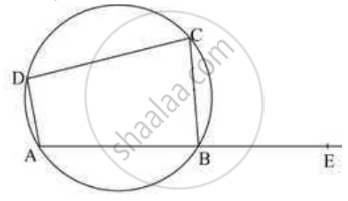
ABCD is a cyclic quadrilateral. M (arc ABC) = 230°. Find ∠ABC, ∠CDA, and ∠CBE.
In the following figure, AOB is a diameter of the circle and C, D, E are any three points on the semi-circle. Find the value of ∠ACD + ∠BED.

ABCD is a parallelogram. A circle through A, B is so drawn that it intersects AD at P and BC at Q. Prove that P, Q, C and D are concyclic.
