Advertisements
Advertisements
Question
If P, Q and R are the mid-points of the sides BC, CA and AB of a triangle and AD is the perpendicular from A on BC, prove that P, Q, R and D are concyclic.
Advertisements
Solution
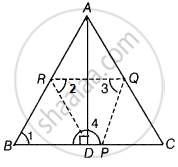
Given: In ΔABC, P, Q and R are the mid-points of the sides BC, CA and AB respectively. Also, AD ⊥ BC.
To prove: P, Q, R and D are concyclic.
Construction: Join DR, RQ and QP
Proof: In right-angled ΔADP, R is the mid-point of AB.
∴ RB = RD
⇒ ∠2 = ∠1 ...(i) [Angles opposite to the equal sides are equal]
Since, R and Q are the mid-points of AB and AC, then
RQ || BC ...[By mid-point theorem]
or RQ || BP
Since, QP || RB, then quadrilateral BPQR is a parallelogram.
⇒ ∠1 = ∠3 ...(ii) [Opposite angles of parallelogram are equal]
From equations (i) and (ii),
∠2 = ∠3
But ∠2 + ∠4 = 180° ...[Linear pair axiom]
∴ ∠3 + ∠4 = 180° ...[∴ ∠2 = ∠3]
Hence, quadrilateral PQRD is a cyclic quadrilateral.
So, points P, Q, R and D are non-cyclic.
Hence proved.
APPEARS IN
RELATED QUESTIONS
Prove that ‘Opposite angles of a cyclic quadrilateral are supplementary’.
A chord of a circle is equal to the radius of the circle. Find the angle subtended by the chord at a point on the minor arc and also at a point on the major arc.
If the non-parallel sides of a trapezium are equal, prove that it is cyclic.
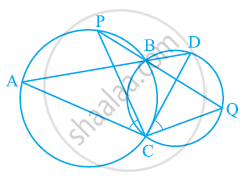
Two circles intersect at two points B and C. Through B, two line segments ABD and PBQ are drawn to intersect the circles at A, D and P, Q respectively (see the given figure). Prove that ∠ACP = ∠QCD.
Let the vertex of an angle ABC be located outside a circle and let the sides of the angle intersect equal chords AD and CE with the circle. Prove that ∠ABC is equal to half the difference of the angles subtended by the chords AC and DE at the centre.
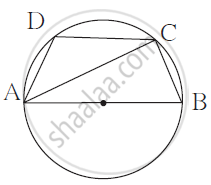
In the figure, `square`ABCD is a cyclic quadrilateral. Seg AB is a diameter. If ∠ ADC = 120˚, complete the following activity to find measure of ∠ BAC.
`square` ABCD is a cyclic quadrilateral.
∴ ∠ ADC + ∠ ABC = 180°
∴ 120˚ + ∠ ABC = 180°
∴ ∠ ABC = ______
But ∠ ACB = ______ .......(angle in semicircle)
In Δ ABC,
∠ BAC + ∠ ACB + ∠ ABC = 180°
∴ ∠BAC + ______ = 180°
∴ ∠ BAC = ______
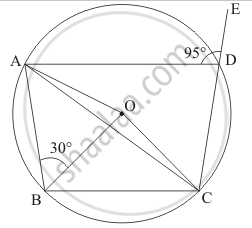
In the given figure, ABCD is a quadrilateral inscribed in a circle with centre O. CD is produced to E such that ∠AED = 95° and ∠OBA = 30°. Find ∠OAC.
ABCD is a cyclic quadrilateral. M (arc ABC) = 230°. Find ∠ABC, ∠CDA, and ∠CBE.
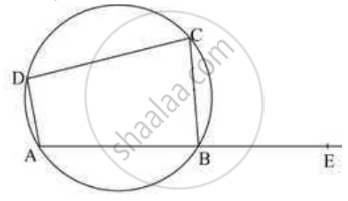
ABCD is a parallelogram. A circle through A, B is so drawn that it intersects AD at P and BC at Q. Prove that P, Q, C and D are concyclic.
If bisectors of opposite angles of a cyclic quadrilateral ABCD intersect the circle, circumscribing it at the points P and Q, prove that PQ is a diameter of the circle.
