Advertisements
Advertisements
Question
In a cyclic quadrilateral ABCD, if ∠A − ∠C = 60°, prove that the smaller of two is 60°
Advertisements
Solution
It is given that ∠A – ∠C = 60° and ABCD is a cyclic quadrilateral.
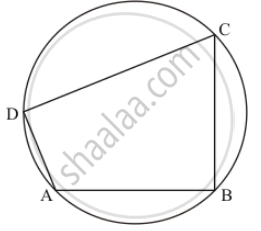
We have to prove that smaller of two is 60°
Since ABCD is a cyclic quadrilateral
So ∠A + ∠C = 180° (Sum of opposite pair of angles of cyclic quadrilateral is 180°) ..… (1)
And,
∠A – ∠C = 60° (Given) ..… (2)
Adding equation (1) and (2) we have
`2angle A = 240° `
`angle A =( 240° )/2`
= 120°
So, ∠C = 60°
Hence, smaller of two is 60°.
APPEARS IN
RELATED QUESTIONS
A chord of a circle is equal to the radius of the circle. Find the angle subtended by the chord at a point on the minor arc and also at a point on the major arc.
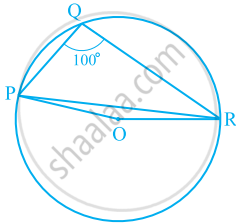
In the given figure, ∠PQR = 100°, where P, Q and R are points on a circle with centre O. Find ∠OPR.
ABCD is a cyclic quadrilateral whose diagonals intersect at a point E. If ∠DBC = 70°, ∠BAC is 30°, find ∠BCD. Further, if AB = BC, find ∠ECD.
If diagonals of a cyclic quadrilateral are diameters of the circle through the vertices of the quadrilateral, prove that it is a rectangle.
Prove that a cyclic parallelogram is a rectangle.
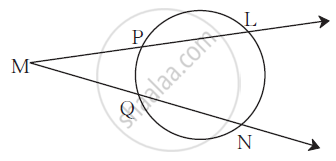
In the figure m(arc LN) = 110°,
m(arc PQ) = 50° then complete the following activity to find ∠LMN.
∠ LMN = `1/2` [m(arc LN) - _______]
∴ ∠ LMN = `1/2` [_________ - 50°]
∴ ∠ LMN = `1/2` × _________
∴ ∠ LMN = __________
ABCD is a cyclic quadrilateral in BC || AD, ∠ADC = 110° and ∠BAC = 50°. Find ∠DAC.
Prove that the perpendicular bisectors of the sides of a cyclic quadrilateral are concurrent.
ABCD is a cyclic quadrilateral such that ∠ADB = 30° and ∠DCA = 80°, then ∠DAB =
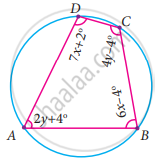
Find all the angles of the given cyclic quadrilateral ABCD in the figure.