Advertisements
Advertisements
Question
ABCD is a cyclic quadrilateral in which BA and CD when produced meet in E and EA = ED. Prove that AD || BC .
Advertisements
Solution
If ABCD is a cyclic quadrilateral in which AB and CD when produced meet in E such that EA = ED, then we have to prove the following, AD || BC
It is given that EA = ED, so
Since, ABCD is cyclic quadrilateral
`x + angleABC = 180 ⇒ angleDAB = 180 - x`
And ; ` x + angleBCD = 180 ⇒ angle BCD = 180- x `
Now,
`angle DAB + angle ABC = x + 180 - x = 180`
Therefore, the adjacent angles `angleDAB ` and `angleABC` are supplementary
Hence, AD || BC
APPEARS IN
RELATED QUESTIONS
Prove that ‘Opposite angles of a cyclic quadrilateral are supplementary’.
If diagonals of a cyclic quadrilateral are diameters of the circle through the vertices of the quadrilateral, prove that it is a rectangle.
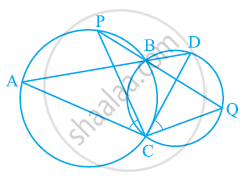
Two circles intersect at two points B and C. Through B, two line segments ABD and PBQ are drawn to intersect the circles at A, D and P, Q respectively (see the given figure). Prove that ∠ACP = ∠QCD.
ABC and ADC are two right triangles with common hypotenuse AC. Prove that ∠CAD = ∠CBD.
The lengths of two parallel chords of a circle are 6 cm and 8 cm. If the smaller chord is at distance 4 cm from the centre, what is the distance of the other chord from the centre?
Bisectors of angles A, B and C of a triangle ABC intersect its circumcircle at D, E and F respectively. Prove that the angles of the triangle DEF are 90°-A, 90° − `1/2 A, 90° − 1/2 B, 90° − 1/2` C.
Prove that the circles described on the four sides of a rhombus as diameters, pass through the point of intersection of its diagonals.
Find all the angles of the given cyclic quadrilateral ABCD in the figure.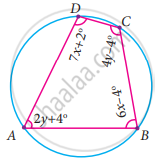
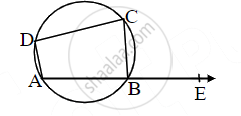
In the figure, ▢ABCD is a cyclic quadrilateral. If m(arc ABC) = 230°, then find ∠ABC, ∠CDA, ∠CBE.
ABCD is a parallelogram. A circle through A, B is so drawn that it intersects AD at P and BC at Q. Prove that P, Q, C and D are concyclic.
