Advertisements
Advertisements
Question
ABCD is a cyclic quadrilateral in which BA and CD when produced meet in E and EA = ED. Prove that EB = EC.
Advertisements
Solution
EB = EC

Since, AD and BC are parallel to each other, so,
\[\angle ECB = \angle EDA \left( \text{ Corresponding angles } \right)\]
\[\angle EBC = \angle EAD \left( \text{ Corresponding angles} \right)\]
\[\text{ But } , \angle EDA = \angle EAD\]
\[\text{ Therefore } , \angle ECB = \angle EBC\]
\[ \Rightarrow EC = EB\]
\[ \text{ Therefore, } \bigtriangleup \text{ ECB is an isosceles triangle } .\]
APPEARS IN
RELATED QUESTIONS
A chord of a circle is equal to the radius of the circle. Find the angle subtended by the chord at a point on the minor arc and also at a point on the major arc.
Two chords AB and CD of lengths 5 cm 11cm respectively of a circle are parallel to each other and are on opposite sides of its centre. If the distance between AB and CD is 6 cm, find the radius of the circle.
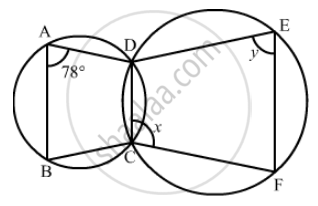
In the given figure, ∠BAD = 78°, ∠DCF = x° and ∠DEF = y°. Find the values of x and y.
Prove that the circles described on the four sides of a rhombus as diameters, pass through the point of intersection of its diagonals.
ABCD is a cyclic quadrilateral in which BA and CD when produced meet in E and EA = ED. Prove that AD || BC .
ABCD is a cyclic quadrilateral such that ∠ADB = 30° and ∠DCA = 80°, then ∠DAB =
ABCD is a cyclic quadrilateral such that AB is a diameter of the circle circumscribing it and ∠ADC = 140º, then ∠BAC is equal to ______.
If a line is drawn parallel to the base of an isosceles triangle to intersect its equal sides, prove that the quadrilateral so formed is cyclic.
If a pair of opposite sides of a cyclic quadrilateral are equal, prove that its diagonals are also equal.
If P, Q and R are the mid-points of the sides BC, CA and AB of a triangle and AD is the perpendicular from A on BC, prove that P, Q, R and D are concyclic.
