Advertisements
Advertisements
Question
Circles are described on the sides of a triangle as diameters. Prove that the circles on any two sides intersect each other on the third side (or third side produced).
Advertisements
Solution
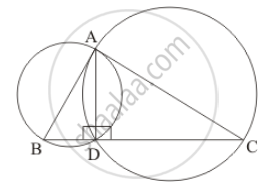
\[\angle ADB = 90° \left( \text{ Angle in a semicircle } \right)\]
\[\angle ADC = 90° \left( \text{ Angle in a semicircle } \right)\]
\[\text{ So } , \angle ADB + \angle ADC = 90° + 90° = 180\]
\[\text{ Therefore, BDC is a line } . \]
\[\text{ Hence, the point of intersection of two circles lie on the third side } .\]
APPEARS IN
RELATED QUESTIONS
Prove that ‘Opposite angles of a cyclic quadrilateral are supplementary’.
If the non-parallel sides of a trapezium are equal, prove that it is cyclic.
Prove that the line of centres of two intersecting circles subtends equal angles at the two points of intersection.
Let the vertex of an angle ABC be located outside a circle and let the sides of the angle intersect equal chords AD and CE with the circle. Prove that ∠ABC is equal to half the difference of the angles subtended by the chords AC and DE at the centre.
Bisectors of angles A, B and C of a triangle ABC intersect its circumcircle at D, E and F respectively. Prove that the angles of the triangle DEF are 90°-A, 90° − `1/2 A, 90° − 1/2 B, 90° − 1/2` C.
ABCD is a cyclic quadrilateral in ∠DBC = 80° and ∠BAC = 40°. Find ∠BCD.
Prove that the circles described on the four sides of a rhombus as diameters, pass through the point of intersection of its diagonals.
ABCD is a cyclic quadrilateral such that ∠ADB = 30° and ∠DCA = 80°, then ∠DAB =
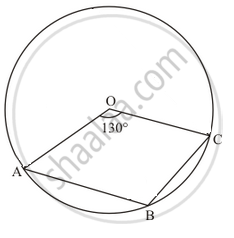
In the given figure, O is the centre of the circle such that ∠AOC = 130°, then ∠ABC =
If non-parallel sides of a trapezium are equal, prove that it is cyclic.
