Advertisements
Advertisements
Question
ABCD is a cyclic quadrilateral in ∠BCD = 100° and ∠ABD = 70° find ∠ADB.
Advertisements
Solution
It is given that, ∠BCD = 100° and ∠ABD = 70°
As we know that sum of the opposite pair of angles of cyclic quadrilateral is 180°.
\[\angle ADC + \angle ABC = 180° \]
\[ \Rightarrow 180° - 80° + 180° - x = 180°\]
\[ \Rightarrow x = 100°\]
In ΔABD we have,
\[\angle DAB + \angle ABD + \angle BDA = 180° \]
\[ \Rightarrow \angle BDA = 180° - 150° = 30° \]
Hence, `angle ABD = 30°`
APPEARS IN
RELATED QUESTIONS
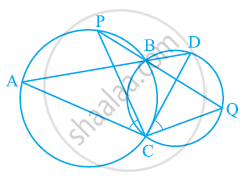
Two circles intersect at two points B and C. Through B, two line segments ABD and PBQ are drawn to intersect the circles at A, D and P, Q respectively (see the given figure). Prove that ∠ACP = ∠QCD.
Let the vertex of an angle ABC be located outside a circle and let the sides of the angle intersect equal chords AD and CE with the circle. Prove that ∠ABC is equal to half the difference of the angles subtended by the chords AC and DE at the centre.
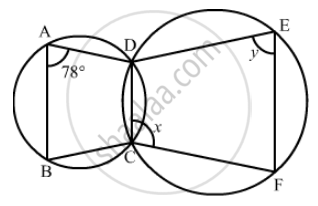
In the given figure, ∠BAD = 78°, ∠DCF = x° and ∠DEF = y°. Find the values of x and y.
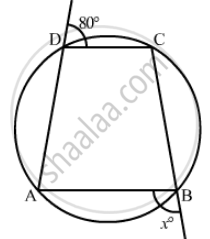
In the given figure, ABCD is a cyclic quadrilateral. Find the value of x.
If the two sides of a pair of opposite sides of a cyclic quadrilateral are equal, prove that its diagonals are equal.
Circles are described on the sides of a triangle as diameters. Prove that the circles on any two sides intersect each other on the third side (or third side produced).
ABCD is a cyclic quadrilateral in which BA and CD when produced meet in E and EA = ED. Prove that EB = EC.
If a pair of opposite sides of a cyclic quadrilateral are equal, prove that its diagonals are also equal.
In the following figure, AOB is a diameter of the circle and C, D, E are any three points on the semi-circle. Find the value of ∠ACD + ∠BED.

The three angles of a quadrilateral are 100°, 60°, 70°. Find the fourth angle.
