Advertisements
Advertisements
Question
If diagonals of a cyclic quadrilateral are diameters of the circle through the vertices of the quadrilateral, prove that it is a rectangle.
Advertisements
Solution

Let ABCD be a cyclic quadrilateral having diagonals BD and AC, intersecting each other at point O.
∠BAD = `1/2angleBOD`
= `180^@/2`
= 90° ...(Consider BD as a chord)
∠BCD + ∠BAD = 180° ...(Cyclic quadrilateral)
∠BCD = 180° − 90° = 90°
∠ADC = `1/2angleAOC`
= `1/2(180^@)`
= 90° ...(Considering AC as a chord)
∠ADC + ∠ABC = 180° ...(Cyclic quadrilateral)
90° + ∠ABC = 180°
∠ABC = 90°
Each interior angle of a cyclic quadrilateral is of 90°. Hence, it is a rectangle.
APPEARS IN
RELATED QUESTIONS
Prove that the circle drawn with any side of a rhombus as diameter passes through the point of intersection of its diagonals.
AC and BD are chords of a circle which bisect each other. Prove that (i) AC and BD are diameters; (ii) ABCD is a rectangle.
Two chords AB and CD of lengths 5 cm 11cm respectively of a circle are parallel to each other and are on opposite sides of its centre. If the distance between AB and CD is 6 cm, find the radius of the circle.
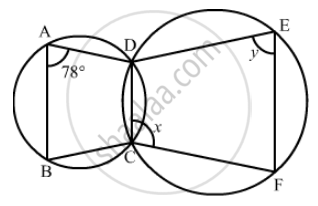
In the given figure, ∠BAD = 78°, ∠DCF = x° and ∠DEF = y°. Find the values of x and y.
In a cyclic quadrilateral ABCD, if ∠A − ∠C = 60°, prove that the smaller of two is 60°
ABCD is a cyclic quadrilateral in ∠DBC = 80° and ∠BAC = 40°. Find ∠BCD.
If the two sides of a pair of opposite sides of a cyclic quadrilateral are equal, prove that its diagonals are equal.
Prove that the centre of the circle circumscribing the cyclic rectangle ABCD is the point of intersection of its diagonals.
ABCD is a cyclic quadrilateral such that ∠ADB = 30° and ∠DCA = 80°, then ∠DAB =
If a pair of opposite sides of a cyclic quadrilateral are equal, prove that its diagonals are also equal.
