Advertisements
Advertisements
Question
ABCD is a cyclic quadrilateral whose diagonals intersect at a point E. If ∠DBC = 70°, ∠BAC is 30°, find ∠BCD. Further, if AB = BC, find ∠ECD.
Advertisements
Solution

For chord CD,
∠CBD = ∠CAD ...(Angles in the same segment)
∠CAD = 70°
∠BAD = ∠BAC + ∠CAD = 30° + 70° = 100°
∠BCD + ∠BAD = 180° ...(Opposite angles of a cyclic quadrilateral)
∠BCD + 100° = 180°
∠BCD = 80°
In ΔABC,
AB = BC ...(Given)
∴ ∠BCA = ∠CAB ...(Angles opposite to equal sides of a triangle)
⇒ ∠BCA = 30°
We have, ∠BCD = 80°
⇒ ∠BCA + ∠ACD = 80°
30° + ∠ACD = 80°
⇒ ∠ACD = 50°
⇒ ∠ECD = 50°
APPEARS IN
RELATED QUESTIONS
Prove that the line of centres of two intersecting circles subtends equal angles at the two points of intersection.
Bisectors of angles A, B and C of a triangle ABC intersect its circumcircle at D, E and F respectively. Prove that the angles of the triangle DEF are 90°-A, 90° − `1/2 A, 90° − 1/2 B, 90° − 1/2` C.
Prove that the perpendicular bisectors of the sides of a cyclic quadrilateral are concurrent.
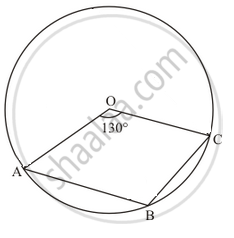
In the given figure, O is the centre of the circle such that ∠AOC = 130°, then ∠ABC =
ABCD is a cyclic quadrilateral. M (arc ABC) = 230°. Find ∠ABC, ∠CDA, and ∠CBE.
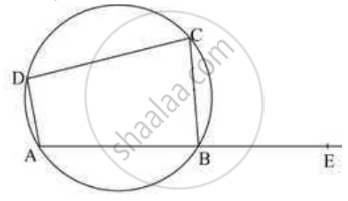
In a cyclic quadrilaterals ABCD, ∠A = 4x, ∠C = 2x the value of x is
In the figure, ▢ABCD is a cyclic quadrilateral. If m(arc ABC) = 230°, then find ∠ABC, ∠CDA, ∠CBE.
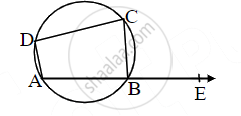
ABCD is a cyclic quadrilateral such that AB is a diameter of the circle circumscribing it and ∠ADC = 140º, then ∠BAC is equal to ______.
If a pair of opposite sides of a cyclic quadrilateral are equal, prove that its diagonals are also equal.
The three angles of a quadrilateral are 100°, 60°, 70°. Find the fourth angle.
