Advertisements
Advertisements
प्रश्न
ABCD is a cyclic quadrilateral whose diagonals intersect at a point E. If ∠DBC = 70°, ∠BAC is 30°, find ∠BCD. Further, if AB = BC, find ∠ECD.
Advertisements
उत्तर

For chord CD,
∠CBD = ∠CAD ...(Angles in the same segment)
∠CAD = 70°
∠BAD = ∠BAC + ∠CAD = 30° + 70° = 100°
∠BCD + ∠BAD = 180° ...(Opposite angles of a cyclic quadrilateral)
∠BCD + 100° = 180°
∠BCD = 80°
In ΔABC,
AB = BC ...(Given)
∴ ∠BCA = ∠CAB ...(Angles opposite to equal sides of a triangle)
⇒ ∠BCA = 30°
We have, ∠BCD = 80°
⇒ ∠BCA + ∠ACD = 80°
30° + ∠ACD = 80°
⇒ ∠ACD = 50°
⇒ ∠ECD = 50°
APPEARS IN
संबंधित प्रश्न
Prove that ‘Opposite angles of a cyclic quadrilateral are supplementary’.
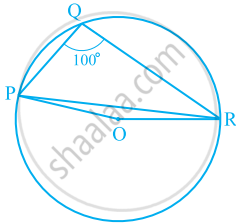
In the given figure, ∠PQR = 100°, where P, Q and R are points on a circle with centre O. Find ∠OPR.
If the non-parallel sides of a trapezium are equal, prove that it is cyclic.
ABC and ADC are two right triangles with common hypotenuse AC. Prove that ∠CAD = ∠CBD.
Two congruent circles intersect each other at points A and B. Through A any line segment PAQ is drawn so that P, Q lie on the two circles. Prove that BP = BQ.
Circles are described on the sides of a triangle as diameters. Prove that the circles on any two sides intersect each other on the third side (or third side produced).
ABCD is a cyclic quadrilateral such that ∠ADB = 30° and ∠DCA = 80°, then ∠DAB =
If a line is drawn parallel to the base of an isosceles triangle to intersect its equal sides, prove that the quadrilateral so formed is cyclic.
ABCD is a parallelogram. A circle through A, B is so drawn that it intersects AD at P and BC at Q. Prove that P, Q, C and D are concyclic.
The three angles of a quadrilateral are 100°, 60°, 70°. Find the fourth angle.
