Advertisements
Advertisements
प्रश्न
Prove that the perpendicular bisectors of the sides of a cyclic quadrilateral are concurrent.
Advertisements
उत्तर
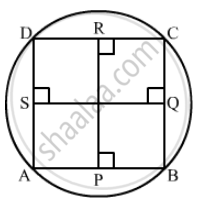
To prove: Perpendicular bisector of side AB, BC, CD and DA are concurrent i.e, passes through the same point.
Proof:
We know that the perpendicular bisector of every chord of a circle always passes through the centre.
Therefore, Perpendicular bisectors of chord AB, BC, CD and DA pass through the centre which means they all passes through the same point.
Hence, the perpendicular bisector of AB, BC, CD and DA are concurrent.
APPEARS IN
संबंधित प्रश्न
Prove that ‘Opposite angles of a cyclic quadrilateral are supplementary’.
Prove that a cyclic parallelogram is a rectangle.
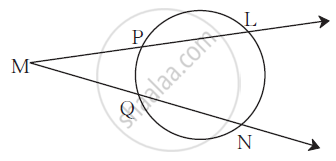
In the figure m(arc LN) = 110°,
m(arc PQ) = 50° then complete the following activity to find ∠LMN.
∠ LMN = `1/2` [m(arc LN) - _______]
∴ ∠ LMN = `1/2` [_________ - 50°]
∴ ∠ LMN = `1/2` × _________
∴ ∠ LMN = __________
In a cyclic quadrilateral ABCD, if ∠A − ∠C = 60°, prove that the smaller of two is 60°
ABCD is a cyclic quadrilateral in BC || AD, ∠ADC = 110° and ∠BAC = 50°. Find ∠DAC.
In the given figure, ABCD is a quadrilateral inscribed in a circle with centre O. CD is produced to E such that ∠AED = 95° and ∠OBA = 30°. Find ∠OAC.

In a cyclic quadrilaterals ABCD, ∠A = 4x, ∠C = 2x the value of x is
ABCD is a cyclic quadrilateral such that ∠A = 90°, ∠B = 70°, ∠C = 95° and ∠D = 105°.
If a line is drawn parallel to the base of an isosceles triangle to intersect its equal sides, prove that the quadrilateral so formed is cyclic.
If P, Q and R are the mid-points of the sides BC, CA and AB of a triangle and AD is the perpendicular from A on BC, prove that P, Q, R and D are concyclic.
