Advertisements
Advertisements
प्रश्न
AC and BD are chords of a circle which bisect each other. Prove that (i) AC and BD are diameters; (ii) ABCD is a rectangle.
Advertisements
उत्तर
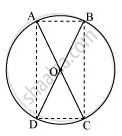
Let two chords AB and CD are intersecting each other at point O.
In ΔAOB and ΔCOD,
OA = OC (Given)
OB = OD (Given)
∠AOB = ∠COD (Vertically opposite angles)
ΔAOB ≅ ΔCOD (SAS congruence rule)
AB = CD (By CPCT)
Similarly, it can be proved that ΔAOD ≅ ΔCOB
∴ AD = CB (By CPCT)
Since in quadrilateral ACBD, opposite sides are equal in length, ACBD is a parallelogram.
We know that opposite angles of a parallelogram are equal.
∴ ∠A = ∠C
However, ∠A + ∠C = 180° (ABCD is a cyclic quadrilateral)
⇒ ∠A + ∠A = 180°
⇒ 2 ∠A = 180°
⇒ ∠A = 90°
As ACBD is a parallelogram and one of its interior angles is 90°, therefore, it is a rectangle.
∠A is the angle subtended by chord BD. And as ∠A = 90°, therefore, BD should be the diameter of the circle. Similarly, AC is the diameter of the circle.
संबंधित प्रश्न
A chord of a circle is equal to the radius of the circle. Find the angle subtended by the chord at a point on the minor arc and also at a point on the major arc.
If circles are drawn taking two sides of a triangle as diameters, prove that the point of intersection of these circles lie on the third side.
Prove that a cyclic parallelogram is a rectangle.
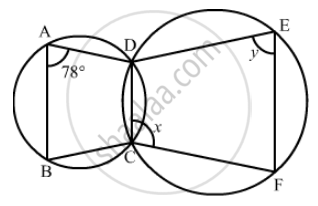
In the given figure, ∠BAD = 78°, ∠DCF = x° and ∠DEF = y°. Find the values of x and y.
ABCD is a cyclic quadrilateral in ∠DBC = 80° and ∠BAC = 40°. Find ∠BCD.
Circles are described on the sides of a triangle as diameters. Prove that the circles on any two sides intersect each other on the third side (or third side produced).
Find all the angles of the given cyclic quadrilateral ABCD in the figure.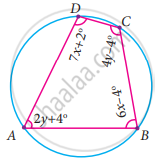
In a cyclic quadrilaterals ABCD, ∠A = 4x, ∠C = 2x the value of x is
If non-parallel sides of a trapezium are equal, prove that it is cyclic.
The three angles of a quadrilateral are 100°, 60°, 70°. Find the fourth angle.
