Advertisements
Advertisements
प्रश्न
In the following figure, AOB is a diameter of the circle and C, D, E are any three points on the semi-circle. Find the value of ∠ACD + ∠BED.

Advertisements
उत्तर
Since, A, C, D and E are four point on a circle, then ACDE is a cyclic quadrilateral.
∠ACD + ∠AED = 180° ...(i) [Sum of opposite angles in a cyclic quadrilateral is 180°]
Now, ∠AEB = 90° ...(ii)
We know that, diameter subtends a right angle to the circle.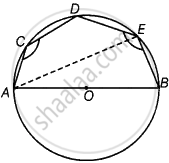
On adding equations (i) and (ii), we get
(∠ACD + ∠AED) + ∠AEB = 180° + 90° = 270°
⇒ ∠ACD + ∠BED = 270°
APPEARS IN
संबंधित प्रश्न
If the non-parallel sides of a trapezium are equal, prove that it is cyclic.
If circles are drawn taking two sides of a triangle as diameters, prove that the point of intersection of these circles lie on the third side.
Prove that the line of centres of two intersecting circles subtends equal angles at the two points of intersection.
Prove that the circle drawn with any side of a rhombus as diameter passes through the point of intersection of its diagonals.
AC and BD are chords of a circle which bisect each other. Prove that (i) AC and BD are diameters; (ii) ABCD is a rectangle.
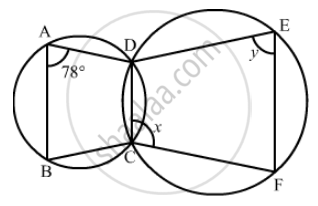
In the given figure, ∠BAD = 78°, ∠DCF = x° and ∠DEF = y°. Find the values of x and y.
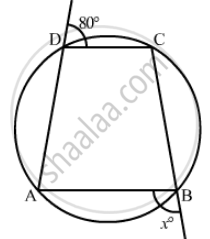
In the given figure, ABCD is a cyclic quadrilateral. Find the value of x.
Prove that the perpendicular bisectors of the sides of a cyclic quadrilateral are concurrent.
ABCD is a cyclic quadrilateral in which BA and CD when produced meet in E and EA = ED. Prove that AD || BC .
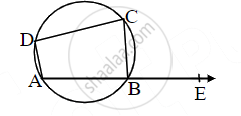
In the figure, ▢ABCD is a cyclic quadrilateral. If m(arc ABC) = 230°, then find ∠ABC, ∠CDA, ∠CBE.