Advertisements
Advertisements
Question
AC and BD are chords of a circle which bisect each other. Prove that (i) AC and BD are diameters; (ii) ABCD is a rectangle.
Advertisements
Solution
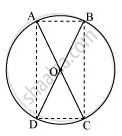
Let two chords AB and CD are intersecting each other at point O.
In ΔAOB and ΔCOD,
OA = OC (Given)
OB = OD (Given)
∠AOB = ∠COD (Vertically opposite angles)
ΔAOB ≅ ΔCOD (SAS congruence rule)
AB = CD (By CPCT)
Similarly, it can be proved that ΔAOD ≅ ΔCOB
∴ AD = CB (By CPCT)
Since in quadrilateral ACBD, opposite sides are equal in length, ACBD is a parallelogram.
We know that opposite angles of a parallelogram are equal.
∴ ∠A = ∠C
However, ∠A + ∠C = 180° (ABCD is a cyclic quadrilateral)
⇒ ∠A + ∠A = 180°
⇒ 2 ∠A = 180°
⇒ ∠A = 90°
As ACBD is a parallelogram and one of its interior angles is 90°, therefore, it is a rectangle.
∠A is the angle subtended by chord BD. And as ∠A = 90°, therefore, BD should be the diameter of the circle. Similarly, AC is the diameter of the circle.
RELATED QUESTIONS
Prove that ‘Opposite angles of a cyclic quadrilateral are supplementary’.
If circles are drawn taking two sides of a triangle as diameters, prove that the point of intersection of these circles lie on the third side.
Prove that a cyclic parallelogram is a rectangle.
ABCD is a cyclic trapezium with AD || BC. If ∠B = 70°, determine other three angles of the trapezium.
Prove that the centre of the circle circumscribing the cyclic rectangle ABCD is the point of intersection of its diagonals.
ABCD is a cyclic quadrilateral in which BA and CD when produced meet in E and EA = ED. Prove that AD || BC .
In the given figure, ABCD is a quadrilateral inscribed in a circle with centre O. CD is produced to E such that ∠AED = 95° and ∠OBA = 30°. Find ∠OAC.

ABCD is a cyclic quadrilateral such that ∠ADB = 30° and ∠DCA = 80°, then ∠DAB =
ABCD is a cyclic quadrilateral such that ∠A = 90°, ∠B = 70°, ∠C = 95° and ∠D = 105°.
If a pair of opposite sides of a cyclic quadrilateral are equal, prove that its diagonals are also equal.
