Advertisements
Advertisements
Question
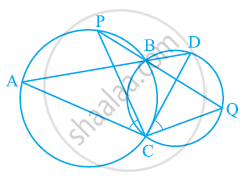
Two circles intersect at two points B and C. Through B, two line segments ABD and PBQ are drawn to intersect the circles at A, D and P, Q respectively (see the given figure). Prove that ∠ACP = ∠QCD.
Advertisements
Solution
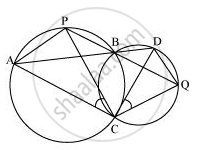
Join chords AP and DQ.
For chord AP,
∠PBA = ∠ACP (Angles in the same segment) ... (1)
For chord DQ,
∠DBQ = ∠QCD (Angles in the same segment) ... (2)
ABD and PBQ are line segments intersecting at B.
∴ ∠PBA = ∠DBQ (Vertically opposite angles) ... (3)
From equations (1), (2), and (3), we obtain
∠ACP = ∠QCD
APPEARS IN
RELATED QUESTIONS
If circles are drawn taking two sides of a triangle as diameters, prove that the point of intersection of these circles lie on the third side.
Two chords AB and CD of lengths 5 cm 11cm respectively of a circle are parallel to each other and are on opposite sides of its centre. If the distance between AB and CD is 6 cm, find the radius of the circle.
If the two sides of a pair of opposite sides of a cyclic quadrilateral are equal, prove that its diagonals are equal.
Circles are described on the sides of a triangle as diameters. Prove that the circles on any two sides intersect each other on the third side (or third side produced).
Prove that the perpendicular bisectors of the sides of a cyclic quadrilateral are concurrent.
In the given figure, ABCD is a quadrilateral inscribed in a circle with centre O. CD is produced to E such that ∠AED = 95° and ∠OBA = 30°. Find ∠OAC.

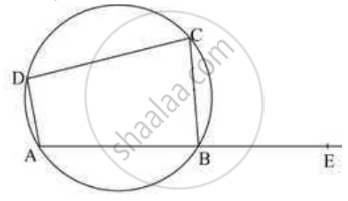
ABCD is a cyclic quadrilateral. M (arc ABC) = 230°. Find ∠ABC, ∠CDA, and ∠CBE.
Find all the angles of the given cyclic quadrilateral ABCD in the figure.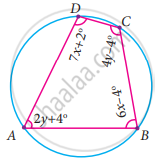
ABCD is a parallelogram. A circle through A, B is so drawn that it intersects AD at P and BC at Q. Prove that P, Q, C and D are concyclic.
The three angles of a quadrilateral are 100°, 60°, 70°. Find the fourth angle.
