Advertisements
Advertisements
प्रश्न
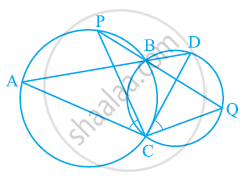
Two circles intersect at two points B and C. Through B, two line segments ABD and PBQ are drawn to intersect the circles at A, D and P, Q respectively (see the given figure). Prove that ∠ACP = ∠QCD.
Advertisements
उत्तर
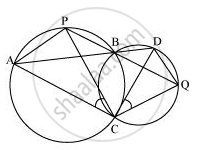
Join chords AP and DQ.
For chord AP,
∠PBA = ∠ACP (Angles in the same segment) ... (1)
For chord DQ,
∠DBQ = ∠QCD (Angles in the same segment) ... (2)
ABD and PBQ are line segments intersecting at B.
∴ ∠PBA = ∠DBQ (Vertically opposite angles) ... (3)
From equations (1), (2), and (3), we obtain
∠ACP = ∠QCD
APPEARS IN
संबंधित प्रश्न
Prove that ‘Opposite angles of a cyclic quadrilateral are supplementary’.
A chord of a circle is equal to the radius of the circle. Find the angle subtended by the chord at a point on the minor arc and also at a point on the major arc.
Two chords AB and CD of lengths 5 cm 11cm respectively of a circle are parallel to each other and are on opposite sides of its centre. If the distance between AB and CD is 6 cm, find the radius of the circle.
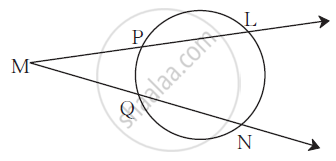
In the figure m(arc LN) = 110°,
m(arc PQ) = 50° then complete the following activity to find ∠LMN.
∠ LMN = `1/2` [m(arc LN) - _______]
∴ ∠ LMN = `1/2` [_________ - 50°]
∴ ∠ LMN = `1/2` × _________
∴ ∠ LMN = __________
ABCD is a cyclic quadrilateral in which BA and CD when produced meet in E and EA = ED. Prove that EB = EC.
Find all the angles of the given cyclic quadrilateral ABCD in the figure.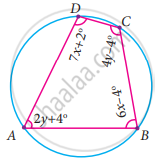
In a cyclic quadrilaterals ABCD, ∠A = 4x, ∠C = 2x the value of x is
If a pair of opposite sides of a cyclic quadrilateral are equal, prove that its diagonals are also equal.
In the following figure, AOB is a diameter of the circle and C, D, E are any three points on the semi-circle. Find the value of ∠ACD + ∠BED.

The three angles of a quadrilateral are 100°, 60°, 70°. Find the fourth angle.
