Advertisements
Advertisements
प्रश्न
In the given figure, ABCD is a quadrilateral inscribed in a circle with centre O. CD is produced to E such that ∠AED = 95° and ∠OBA = 30°. Find ∠OAC.

Advertisements
उत्तर
∠ADE = 95°(Given) Since,
OA = OB, so
∠OAB = ∠OBA
∠OAB = 30°
∠ADE + ∠ADC = 180°
(Linear pair)
95° + ∠ADC = 180°
∠ADC = 85°
We know that,
∠AOC = 2∠ADC
∠AOC = 2 × 85°
∠AOC = 170°
Since,
AO = OC
(Radii of circle)
∠OAC = ∠OCA
(Sides opposite to equal angle) ...(i)
In triangle OAC,
∠OAC + ∠OCA + ∠AOC = 180°
∠OAC + ∠OAC + 170° = 180°
[From (i)]
2∠OAC = 10°
∠OAC = 5°
Thus,
∠OAC = 5°
APPEARS IN
संबंधित प्रश्न
Prove that the circle drawn with any side of a rhombus as diameter passes through the point of intersection of its diagonals.
Two congruent circles intersect each other at points A and B. Through A any line segment PAQ is drawn so that P, Q lie on the two circles. Prove that BP = BQ.
Prove that the circles described on the four sides of a rhombus as diameters, pass through the point of intersection of its diagonals.
ABCD is a cyclic quadrilateral in which BA and CD when produced meet in E and EA = ED. Prove that AD || BC .
ABCD is a cyclic quadrilateral in which BA and CD when produced meet in E and EA = ED. Prove that EB = EC.
In the given figure, O is the centre of the circle such that ∠AOC = 130°, then ∠ABC =
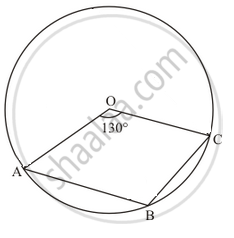
ABCD is a cyclic quadrilateral such that AB is a diameter of the circle circumscribing it and ∠ADC = 140º, then ∠BAC is equal to ______.
ABCD is a cyclic quadrilateral such that ∠A = 90°, ∠B = 70°, ∠C = 95° and ∠D = 105°.
If P, Q and R are the mid-points of the sides BC, CA and AB of a triangle and AD is the perpendicular from A on BC, prove that P, Q, R and D are concyclic.
The three angles of a quadrilateral are 100°, 60°, 70°. Find the fourth angle.
