Advertisements
Advertisements
प्रश्न
ABCD is a cyclic trapezium with AD || BC. If ∠B = 70°, determine other three angles of the trapezium.
Advertisements
उत्तर
If in cyclic quadrilateral `angle B = 70°` , then we have to find the other three angles.
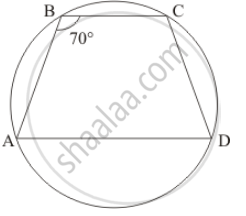
Since, AD is parallel to BC, So,
`angleB + angleA = 180 ` (Alternate interior angles)
`70 + angleA = 180`
`⇒ angle A = 180 - 70 = 110°`
Now, since ABCD is cyclic quadrilateral, so
`angle A + angle C = 180`
`⇒ 110 + angle C = 180`
`⇒ angle C = 180 - 110 = 70°`
And,
`angle B + angleD = 180`\
`⇒ 70 + angleD = 180`
`⇒ angleD = 180 - 70 = 110°`
APPEARS IN
संबंधित प्रश्न
Prove that a cyclic parallelogram is a rectangle.
Let the vertex of an angle ABC be located outside a circle and let the sides of the angle intersect equal chords AD and CE with the circle. Prove that ∠ABC is equal to half the difference of the angles subtended by the chords AC and DE at the centre.
In a cyclic quadrilateral ABCD, if ∠A − ∠C = 60°, prove that the smaller of two is 60°
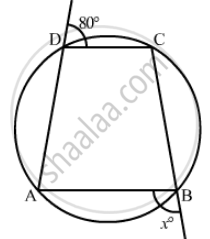
In the given figure, ABCD is a cyclic quadrilateral. Find the value of x.
ABCD is a cyclic quadrilateral in BC || AD, ∠ADC = 110° and ∠BAC = 50°. Find ∠DAC.
Prove that the circles described on the four sides of a rhombus as diameters, pass through the point of intersection of its diagonals.
Prove that the perpendicular bisectors of the sides of a cyclic quadrilateral are concurrent.
ABCD is a cyclic quadrilateral such that AB is a diameter of the circle circumscribing it and ∠ADC = 140º, then ∠BAC is equal to ______.
ABCD is a cyclic quadrilateral such that ∠A = 90°, ∠B = 70°, ∠C = 95° and ∠D = 105°.
If P, Q and R are the mid-points of the sides BC, CA and AB of a triangle and AD is the perpendicular from A on BC, prove that P, Q, R and D are concyclic.
