Advertisements
Advertisements
प्रश्न
The lengths of two parallel chords of a circle are 6 cm and 8 cm. If the smaller chord is at distance 4 cm from the centre, what is the distance of the other chord from the centre?
Advertisements
उत्तर
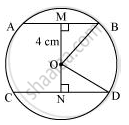
Let AB and CD be two parallel chords in a circle centered at O. Join OB and OD.
Distance of smaller chord AB from the centre of the circle = 4 cm
OM = 4 cm
MB = AB/2 = 6/2 = 3cm
In ΔOMB,
OM2 + MB2 = OB2
(4)2 + (3)2 = OB2
16 + 9 = OB2
OB2 = 25
`OB = sqrt25`
OB = 5cm
In ΔOND,
OD = OB = 5cm (Radii of the same circle)
ND = CD/2 = 8/2 = 4cm
ON2 + ND2 = OD2
ON2 + (4)2 = (5)2
ON2 = 25 - 16 = 9
ON = 3
Therefore, the distance of the bigger chord from the centre is 3 cm.
संबंधित प्रश्न
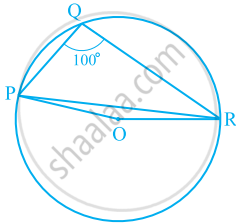
In the given figure, ∠PQR = 100°, where P, Q and R are points on a circle with centre O. Find ∠OPR.
If diagonals of a cyclic quadrilateral are diameters of the circle through the vertices of the quadrilateral, prove that it is a rectangle.
If the non-parallel sides of a trapezium are equal, prove that it is cyclic.
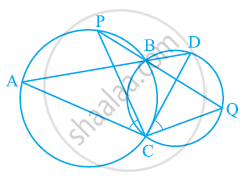
Two circles intersect at two points B and C. Through B, two line segments ABD and PBQ are drawn to intersect the circles at A, D and P, Q respectively (see the given figure). Prove that ∠ACP = ∠QCD.
Two chords AB and CD of lengths 5 cm 11cm respectively of a circle are parallel to each other and are on opposite sides of its centre. If the distance between AB and CD is 6 cm, find the radius of the circle.
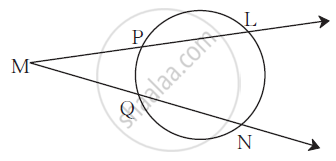
In the figure m(arc LN) = 110°,
m(arc PQ) = 50° then complete the following activity to find ∠LMN.
∠ LMN = `1/2` [m(arc LN) - _______]
∴ ∠ LMN = `1/2` [_________ - 50°]
∴ ∠ LMN = `1/2` × _________
∴ ∠ LMN = __________
Prove that the centre of the circle circumscribing the cyclic rectangle ABCD is the point of intersection of its diagonals.
ABCD is a cyclic quadrilateral such that ∠ADB = 30° and ∠DCA = 80°, then ∠DAB =
Find all the angles of the given cyclic quadrilateral ABCD in the figure.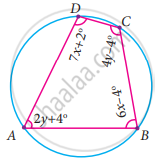
If a line is drawn parallel to the base of an isosceles triangle to intersect its equal sides, prove that the quadrilateral so formed is cyclic.
