Advertisements
Advertisements
प्रश्न
ABCD is a cyclic quadrilateral such that ∠A = 90°, ∠B = 70°, ∠C = 95° and ∠D = 105°.
पर्याय
True
False
Advertisements
उत्तर
This statement is False.
Explanation:
In a cyclic quadrilateral, the sum of opposite angles is 180°.
Now, ∠A + ∠C = 90° + 95° = 185° ≠ 180°
And ∠B + ∠D = 70° + 105° = 175° ≠ 180°
Here, we see that, the sum of opposite angles is not equal to 180°.
So, it is not a cyclic quadrilateral.
APPEARS IN
संबंधित प्रश्न
If diagonals of a cyclic quadrilateral are diameters of the circle through the vertices of the quadrilateral, prove that it is a rectangle.
Prove that a cyclic parallelogram is a rectangle.
Bisectors of angles A, B and C of a triangle ABC intersect its circumcircle at D, E and F respectively. Prove that the angles of the triangle DEF are 90°-A, 90° − `1/2 A, 90° − 1/2 B, 90° − 1/2` C.
In the given figure, ABCD is a cyclic quadrilateral. Find the value of x.
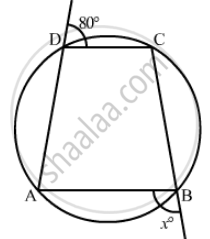
Prove that the perpendicular bisectors of the sides of a cyclic quadrilateral are concurrent.
Prove that the centre of the circle circumscribing the cyclic rectangle ABCD is the point of intersection of its diagonals.
Find all the angles of the given cyclic quadrilateral ABCD in the figure.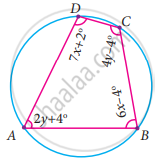
In the following figure, AOB is a diameter of the circle and C, D, E are any three points on the semi-circle. Find the value of ∠ACD + ∠BED.

If non-parallel sides of a trapezium are equal, prove that it is cyclic.
If P, Q and R are the mid-points of the sides BC, CA and AB of a triangle and AD is the perpendicular from A on BC, prove that P, Q, R and D are concyclic.
