Advertisements
Advertisements
Question
A chord of a circle is equal to the radius of the circle. Find the angle subtended by the chord at a point on the minor arc and also at a point on the major arc.
Advertisements
Solution
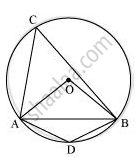
In ΔOAB,
AB = OA = OB = radius
∴ ΔOAB is an equilateral triangle.
Therefore, each interior angle of this triangle will be of 60°.
∴ ∠AOB = 60°
∠ACB = `1/2angleAOB`
∠ACB = `1/2(60^@)`
∠ACB = 30°
In cyclic quadrilateral ACBD,
∠ACB + ∠ADB = 180° ...(Opposite angle in cyclic quadrilateral)
⇒ ∠ADB = 180° − 30° = 150°
Therefore, the angles subtended by this chord at a point on the major arc and the minor arc are 30° and 150° respectively.
APPEARS IN
RELATED QUESTIONS
If the non-parallel sides of a trapezium are equal, prove that it is cyclic.
AC and BD are chords of a circle which bisect each other. Prove that (i) AC and BD are diameters; (ii) ABCD is a rectangle.
Two chords AB and CD of lengths 5 cm 11cm respectively of a circle are parallel to each other and are on opposite sides of its centre. If the distance between AB and CD is 6 cm, find the radius of the circle.
Bisectors of angles A, B and C of a triangle ABC intersect its circumcircle at D, E and F respectively. Prove that the angles of the triangle DEF are 90°-A, 90° − `1/2 A, 90° − 1/2 B, 90° − 1/2` C.
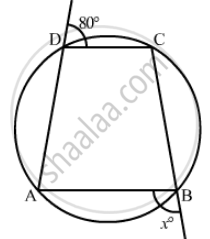
In the given figure, ABCD is a cyclic quadrilateral. Find the value of x.
If the two sides of a pair of opposite sides of a cyclic quadrilateral are equal, prove that its diagonals are equal.
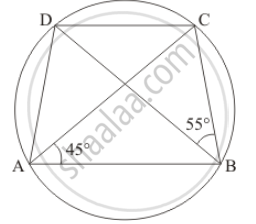
In the given figure, ABCD is a cyclic quadrilateral in which AC and BD are its diagonals. If ∠DBC = 55° and ∠BAC = 45°, find ∠BCD.
Find all the angles of the given cyclic quadrilateral ABCD in the figure.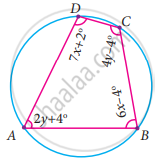
In a cyclic quadrilaterals ABCD, ∠A = 4x, ∠C = 2x the value of x is
The three angles of a quadrilateral are 100°, 60°, 70°. Find the fourth angle.
