Advertisements
Advertisements
Question
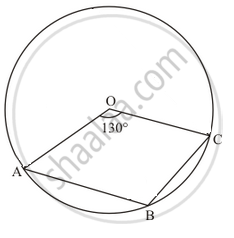
In the given figure, O is the centre of the circle such that ∠AOC = 130°, then ∠ABC =
Options
130°
115°
65°
165°
Advertisements
Solution
115°
We have the following information in the following figure. Take a point P on the circle in the given figure and join AP and CP.
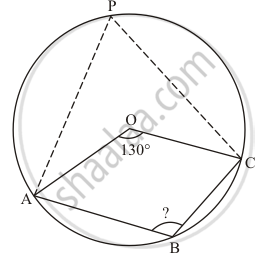
Since, the angle subtended by a chord at the centre is twice that of subtended atany part of the circle.
So, `angleAPC = (angleAOC)/2 = 130/2 = 65°`
Since `squareAPBP` is a cyclic quadrilateral and we known that opposite angles are supplementary.
Therefore,
\[ \Rightarrow \angle ABC + 65° = 180° \]
\[ \Rightarrow \angle ABC = 180° - 65° \]
\[ \Rightarrow \angle ABC = 115°\]
APPEARS IN
RELATED QUESTIONS
Prove that ‘Opposite angles of a cyclic quadrilateral are supplementary’.
Two chords AB and CD of lengths 5 cm 11cm respectively of a circle are parallel to each other and are on opposite sides of its centre. If the distance between AB and CD is 6 cm, find the radius of the circle.
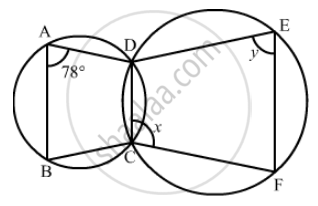
In the given figure, ∠BAD = 78°, ∠DCF = x° and ∠DEF = y°. Find the values of x and y.
In a cyclic quadrilateral ABCD, if ∠A − ∠C = 60°, prove that the smaller of two is 60°
If the two sides of a pair of opposite sides of a cyclic quadrilateral are equal, prove that its diagonals are equal.
ABCD is a cyclic trapezium with AD || BC. If ∠B = 70°, determine other three angles of the trapezium.
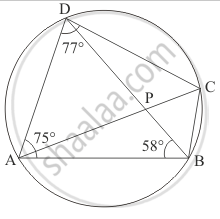
In the given figure, ABCD is a cyclic quadrilateral in which ∠BAD = 75°, ∠ABD = 58° and ∠ADC = 77°, AC and BD intersect at P. Then, find ∠DPC.
In a cyclic quadrilaterals ABCD, ∠A = 4x, ∠C = 2x the value of x is
ABCD is a cyclic quadrilateral such that AB is a diameter of the circle circumscribing it and ∠ADC = 140º, then ∠BAC is equal to ______.
The three angles of a quadrilateral are 100°, 60°, 70°. Find the fourth angle.
