Advertisements
Advertisements
प्रश्न
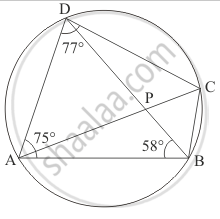
In the given figure, ABCD is a cyclic quadrilateral in which ∠BAD = 75°, ∠ABD = 58° and ∠ADC = 77°, AC and BD intersect at P. Then, find ∠DPC.
Advertisements
उत्तर
In a cyclic quadrilateral it is known that the opposite angles are supplementary, meaning that the opposite angles add up to 180° .
Here we have a cyclic quadrilateral ABCD. The centre of this circle is given as ‘O’.
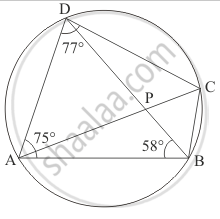
Since in a cyclic quadrilateral the opposite angles are supplementary, here
`angleADC + angleABD + angle CBD ` = 180°
`angleCBD = 180° - angleADC - angleABD `
= 180° - 77° - 58°
`angle CBD ` = 45°
Whenever a chord is drawn in a circle two segments are formed. One is called the minor segment while the other is called the major segment. The angle that the chord forms with any point on the circumference of a particular segment is always the same.
Here, ‘CD’ is a chord and ‘A’ and ‘B’ are two points along the circumference on the major segment formed by the chord ‘CD’.
So, `angleCBD = angleCAD ` = 45°
Now,
`angleBAD = angleBAC + angleCAD `
`angleBAC = angleBAD - angleCAD`
= 75° - 45°
`angleBAC` = 30°
In any triangle the sum of the interior angles need to be equal to 180°.
Consider the triangle ΔABP,
\[\angle PAB + \angle ABP + \angle APB = 180°\]
\[ \Rightarrow \angle APB = 180°- 30°- 58°\]
\[ \Rightarrow \angle APB = 92°\]
From the figure, since ‘AC’ and ‘BD’ intersect at ‘P’ we have,
`angle APB = angleDPC ` = 92°
Hence the measure of `angleDPC ` is92° .
APPEARS IN
संबंधित प्रश्न
Prove that ‘Opposite angles of a cyclic quadrilateral are supplementary’.
If the non-parallel sides of a trapezium are equal, prove that it is cyclic.
If circles are drawn taking two sides of a triangle as diameters, prove that the point of intersection of these circles lie on the third side.
ABCD is a parallelogram. The circle through A, B and C intersect CD (produced if necessary) at E. Prove that AE = AD.
Two chords AB and CD of lengths 5 cm 11cm respectively of a circle are parallel to each other and are on opposite sides of its centre. If the distance between AB and CD is 6 cm, find the radius of the circle.
ABCD is a cyclic quadrilateral such that ∠ADB = 30° and ∠DCA = 80°, then ∠DAB =
PQRS is a cyclic quadrilateral such that PR is a diameter of the circle. If ∠QPR = 67° and ∠SPR = 72°, then ∠QRS =
ABCD is a cyclic quadrilateral such that AB is a diameter of the circle circumscribing it and ∠ADC = 140º, then ∠BAC is equal to ______.
If a line is drawn parallel to the base of an isosceles triangle to intersect its equal sides, prove that the quadrilateral so formed is cyclic.
If bisectors of opposite angles of a cyclic quadrilateral ABCD intersect the circle, circumscribing it at the points P and Q, prove that PQ is a diameter of the circle.
