Advertisements
Advertisements
प्रश्न
Prove that a cyclic parallelogram is a rectangle.
Advertisements
उत्तर

Let ABCD be a cyclic parallelogram.
∠A + ∠C = 180° (Opposite angles of a cyclic quadrilateral) ...(1)
We know that opposite angles of a parallelogram are equal.
∴ ∠A = ∠C and ∠B = ∠D
From equation (1),
∠A + ∠C = 180°
⇒ ∠A + ∠A = 180°
⇒ 2 ∠A = 180°
⇒ ∠A = 90°
Parallelogram ABCD has one of its interior angles, which is 90°. Therefore, it is a rectangle.
APPEARS IN
संबंधित प्रश्न
ABCD is a cyclic quadrilateral whose diagonals intersect at a point E. If ∠DBC = 70°, ∠BAC is 30°, find ∠BCD. Further, if AB = BC, find ∠ECD.
If diagonals of a cyclic quadrilateral are diameters of the circle through the vertices of the quadrilateral, prove that it is a rectangle.
Let the vertex of an angle ABC be located outside a circle and let the sides of the angle intersect equal chords AD and CE with the circle. Prove that ∠ABC is equal to half the difference of the angles subtended by the chords AC and DE at the centre.
Bisectors of angles A, B and C of a triangle ABC intersect its circumcircle at D, E and F respectively. Prove that the angles of the triangle DEF are 90°-A, 90° − `1/2 A, 90° − 1/2 B, 90° − 1/2` C.
ABCD is a cyclic quadrilateral in ∠BCD = 100° and ∠ABD = 70° find ∠ADB.
Prove that the centre of the circle circumscribing the cyclic rectangle ABCD is the point of intersection of its diagonals.
ABCD is a cyclic quadrilateral in which BA and CD when produced meet in E and EA = ED. Prove that EB = EC.
PQRS is a cyclic quadrilateral such that PR is a diameter of the circle. If ∠QPR = 67° and ∠SPR = 72°, then ∠QRS =
Find all the angles of the given cyclic quadrilateral ABCD in the figure.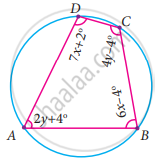
If bisectors of opposite angles of a cyclic quadrilateral ABCD intersect the circle, circumscribing it at the points P and Q, prove that PQ is a diameter of the circle.
