Advertisements
Chapters
2: Compound Interest
3: Expansions
4: Factorisation
5: Simultaneous Linear Equations
6: Indices/Exponents
7: Logarithms
8: Triangles
9: Mid-point Theorem
10: Pythagoras Theorem
▶ 11: Rectilinear Figures
12: Constructions of Polygons
13: Theorems on Area
14: Circles
15: Statistics
16: Mensuration
17: Trigonometric Ratios
18: Trigonometric Ratios of Some Standard Angles and Complementary Angles
19: Co-ordinate Geometry: An Introduction
![Nootan solutions for Mathematics [English] Class 9 ICSE chapter 11 - Rectilinear Figures - Shaalaa.com](/images/mathematics-english-class-9-icse_6:f26eb985e8254aa987299226050d7c71.jpg "Nootan solutions for Mathematics [English] Class 9 ICSE chapter 11 - Rectilinear Figures")
Advertisements
Solutions for Chapter 11: Rectilinear Figures
Below listed, you can find solutions for Chapter 11 of CISCE Nootan for Mathematics [English] Class 9 ICSE.
Nootan solutions for Mathematics [English] Class 9 ICSE 11 Rectilinear Figures Exercise 11A [Pages 231 - 233]
Find the value of x and y from the following parallelogram:
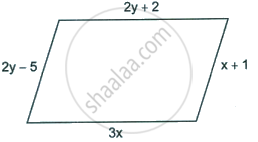
Find the value of x and y from the following parallelogram:
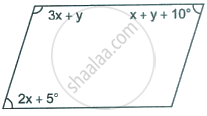
The angles of a quadrilateral are in the ratio 2 : 3 : 3 : 4. Find the angles.
Three angles of a quadrilateral are in the ratio 7 : 8 : 11 and the fourth angle is of 100°. Find the angles.
Two adjacent angles of a parallelogram are 2x + 10° and 4x – 40°. Find the angles of the parallelogram.
Two opposite angles of the parallelogram are 3x – 5° and x + 45°. Find the angles of the parallelogram.
The angles of a quadrilateral are in the ratio 3 : 4 : 5 : 6. Show that it is a trapezium.
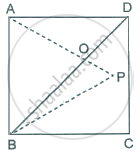
In the adjoining figure, ◻ABCD is a square and ΔABP is an equilateral triangle.
Find :
- ∠AOB
- ∠CPB
- ∠PCD
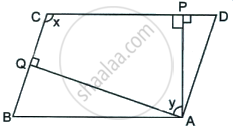
In the adjacent parallelogram ABCD, AP ⊥ CD and AQ ⊥ BC. If x : y = 5 : 4, then find the angles of the parallelogram.
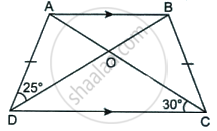
In the adjoining figure, ABCD is an isosceles trapezium in which AB || DC and AD = BС. If ∠ACD = 30° and ∠ADB = 25°, then find:
- ∠AOD
- ∠CBD
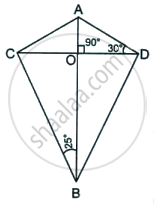
In the adjoining figure, OC = OD.
Find :
- ∠CBD
- ∠CAD
- ∠BCA
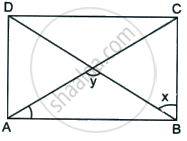
In the adjoining figure, a rectangle ABCD is shown. If CAB = 20°, then find the values of x and y.
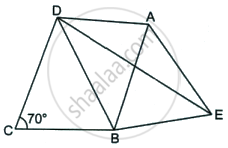
In the adjoining figure, ABCD is a rhombus and ABE is an equilateral triangle. ∠BCD = 70°, find:
- ∠ADE
- ∠BDE
- ∠BED
The diagonals of a rectangle ABCD intersect at P and PAL is an equilateral triangle such that B and L are on the same side of AC. If ∠ACD = 30°, find:
- ∠ALB
- ∠ABL
The diagonals of a quadrilateral ABCD bisect each other. If ∠A = 50°, then find ∠B.
The perimeter of a parallelogram ABCD is 48 cm. If BC = 3x – 2, DA = x + 2y + 2 and AB = 3y + 2, find the values of x and y.
In the parallelogram ABCD, E and F are the mid-points of AB and DC respectively. Prove that AEFD is a parallelogram.
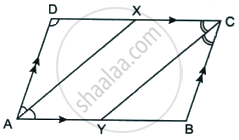
In the adjoining figure, ABCD is a parallelogram. AX and CY are the bisectors of ∠A and ∠C respectively.
Prove that :
- ΔADX ≅ ΔCBY
- AX || CY
- AYCX is a parallelogram.
If a diagonal of a parallelogram bisects one of the angles of the parallelogram and it also bisects the opposite angle then prove that the two diagonals are perpendicular to each other.
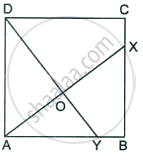
In a square ABCD; A is joined to a point X on BC and D is joined to a point Y on AB. If AX = DY, prove that AX is perpendicular to DY.
In a rhombus ABCD, the altitude from D to side AB bisects AB. Find the angles of the rhombus.
If P and Q are points of trisection of the diagonal BD of a parallelogram ABCD, prove that : CQ || AP.
Prove that a diagonal of a rhombus bisects the angles at the vertices.
In ΔABC, median AD is produced to E such that AD = DE, prove that ABEC is a parallelogram.
In a quadrilateral ABCD, AB = AD and BC = CD.
Prove that :
- AC bisects ∠BAD
- AC is the perpendicular bisector of BD.
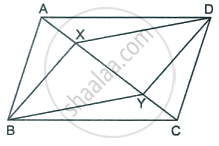
In a parallelogram ABCD; BX is the bisector of ∠ABC and DY is the bisector of ∠ADC. Prove that BXDY is a parallelogram.
In a trapezium ABCD, the diagonals AC and BD intersect at point ‘O’, AB || DC and AD = BC.
Prove that :
- ∠BAD = ∠ABC
- ∠ADC = ∠BCD
- AC = BD
- OA = OB and OC = OD
Prove that the bisectors of interior angles of a parallelogram form a rectangle.
Prove that the bisectors of the interior angles of a rectangle form a square.
The side AB of a parallelogram ABCD is produced to X and the bisector of ∠CBX meets DA produced and DC produced at Y and Z respectively, prove that : DY = DZ = AB + BC.
ABCD is a rhombus. RABS is a straight line such that RA = AB = BS. Prove that RD and SC when produced meet at right angles.
Nootan solutions for Mathematics [English] Class 9 ICSE 11 Rectilinear Figures Exercise 11B [Pages 233 - 234]
Multiple Choice Questions Choose the correct answer from the given four options in each of the following questions :
The angles of a quadrilateral are in the ratio 3 : 3 : 5 : 7. The largest angle is ______.
120°
140°
150°
160°
Three angles of a quadrilateral are equal and fourth angle is 120°. Each of three equal angles is ______.
80°
90°
100°
110°
The two adjacent angles of a parallelogram are in the ratio 3 : 7. The largest angle of the parallelogram is ______.
126°
140°
120°
98°
An angle of a parallelogram is half of its adjacent angle. The smallest angle of a quadrilateral is ______.
30°
80°
45°
60°
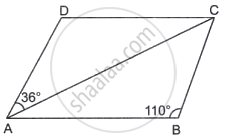
In the adjoining figure, ABCD is a parallelogram. If ∠CAD = 36° and ∠ABC = 110°, then ∠BAC is ______.
36°
34°
72°
74°
A quadrilateral ABCD is a trapezium with AB || DC if ______.
AB = BС
∠A + ∠D = 180°
∠A + ∠B = 180°
∠C + ∠D = 180°
The sum of all four angles of a quadrilateral is ______.
360°
270°
180°
720°
If the diagonals of a quadrilateral bisect each other at right angle then it is a ______.
square
rectangle but not a square
parallelogram but not a square
kite but not a square
In a rectangle ABCD, the diagonals AC and BD intersect at O. If ∠OAB = 27°, ∠COD is equal to ______.
96°
116°
126°
54°
In the parallelogram ABCD, ∠A – ∠B – ∠C + ∠D is equal to ______.
0°
90°
180°
360°
The angle between two altitudes of a parallelogram through the vertex of an obtuse angle of the parallelogram is 55°. The largest angle of the parallelogram is ______.
110°
125°
115°
130°
In a quadrilateral ABCD, AO and BO are the bisectors of ∠A and ∠B respectively, then (∠C + ∠D) is equal to ______.
∠AOB
2∠AOB
3∠AOB
4∠AOB
Solutions for 11: Rectilinear Figures
Nootan solutions for Mathematics [English] Class 9 ICSE chapter 11 - Rectilinear Figures
Shaalaa.com has the CISCE Mathematics Mathematics [English] Class 9 ICSE CISCE solutions in a manner that help students grasp basic concepts better and faster. The detailed, step-by-step solutions will help you understand the concepts better and clarify any confusion. Nootan solutions for Mathematics Mathematics [English] Class 9 ICSE CISCE 11 (Rectilinear Figures) include all questions with answers and detailed explanations. This will clear students' doubts about questions and improve their application skills while preparing for board exams.
Further, we at Shaalaa.com provide such solutions so students can prepare for written exams. Nootan textbook solutions can be a core help for self-study and provide excellent self-help guidance for students.
Concepts covered in Mathematics [English] Class 9 ICSE chapter 11 Rectilinear Figures are .
Using Nootan Mathematics [English] Class 9 ICSE solutions Rectilinear Figures exercise by students is an easy way to prepare for the exams, as they involve solutions arranged chapter-wise and also page-wise. The questions involved in Nootan Solutions are essential questions that can be asked in the final exam. Maximum CISCE Mathematics [English] Class 9 ICSE students prefer Nootan Textbook Solutions to score more in exams.
Get the free view of Chapter 11, Rectilinear Figures Mathematics [English] Class 9 ICSE additional questions for Mathematics Mathematics [English] Class 9 ICSE CISCE, and you can use Shaalaa.com to keep it handy for your exam preparation.
