Advertisements
Advertisements
Question
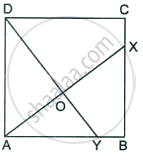
In a square ABCD; A is joined to a point X on BC and D is joined to a point Y on AB. If AX = DY, prove that AX is perpendicular to DY.
Advertisements
Solution
Given: ABCD is a square. A is joined to a point X on BC and D is joined to a point Y on AB. AX = DY.
To Prove: AX is perpendicular to DY.
Proof [Step-wise]:
1. Place coordinates:
Let the side of the square be a.
Put A ≡ (0, 0), B ≡ (a, 0), C ≡ (a, a), D ≡ (0, a).
2. Let X lie on BC.
Then X has coordinates X ≡ (a, t) for some t with 0 ≤ t ≤ a.
3. Let Y lie on AB.
Then Y has coordinates Y ≡ (u, 0) for some u with 0 ≤ u ≤ a.
4. Compute squared lengths:
AX2 = (a – 0)2 + (t – 0)2
= a2 + t2
DY2 = (u – 0)2 + (0 – a)2
= u2 + a2
5. Given AX = DY.
So, AX2 = DY2.
Hence, a2 + t2 = u2 + a2, which simplifies to t2 = u2.
Because t, u ≥ 0 they measure distances along sides, we get t = u.
6. Therefore, X = (a, t) and Y = (t, 0).
The slope of AX is `(t - 0)/(a - 0) = t/a`.
The slope of DY is `(0 - a)/(t - 0) = -a/t`.
7. Multiply slopes:
`(t/a) xx (-a/t) = -1`
Two lines whose slopes multiply to –1 are perpendicular.
Hence, AX ⟂ DY.
