Advertisements
Advertisements
Question
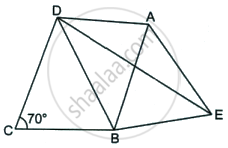
In the adjoining figure, ABCD is a rhombus and ABE is an equilateral triangle. ∠BCD = 70°, find:
- ∠ADE
- ∠BDE
- ∠BED
Advertisements
Solution
Given:
ABCD is a rhombus, ABE is an equilateral triangle and ∠BCD = 70°.
Step-wise calculation:
1. From the rhombus:
Opposite angles are equal and adjacent angles are supplementary.
So, ∠A = ∠C = 70° and ∠B = ∠D = 110°.
Also, a diagonal of a rhombus bisects the vertex angles.
So, diagonal DB bisects ∠D, giving `∠BDA = 1/2 xx110^circ = 55^circ`.
2. From the equilateral triangle ABE:
All sides AB = BE = AE and all angles at A, B, E are 60°.
In particular, AE = AB. ...(Equilateral-triangle)
3. Because ABCD is a rhombus AB = AD and from step 2 AE = AB, we have AD = AE.
Thus, triangle ADE is isosceles with AD = AE.
So, its base angles at D and E are equal.
4. The angle at A of triangle ADE is the angle between AD and AE.
At A, we pass from AD to AB (70° inside the rhombus), then from AB to AE (60° in the equilateral).
So, ∠DAE
= 70° + 60°
= 130°
Therefore, in triangle ADE:
130° + 2 × ∠ADE = 180°
⇒ 2 × ∠ADE = 50°
⇒ ∠ADE = 25°
5. At D, the diagonal DB makes angle ∠BDA = 55° with DA from step 1.
The angle ∠BDE between DB and DE equals ∠BDA – ∠ADE = 55° – 25° = 30°.
Since DE lies on the other side of DA than DB in the figure.
6. Finally, in triangle BDE the three angles must sum to 180°:
∠BDE + ∠DBE + ∠BED = 180°
We already know ∠DBE = 115°
This follows from the bisected angle at B (55°) combined with ∠ABE = 60° and ∠BDE = 30°.
So, ∠BED
= 180° – 30° – 115°
= 35°
- ∠ADE = 25°
- ∠BDE = 30°
- ∠BED = 35°
