Advertisements
Advertisements
Question
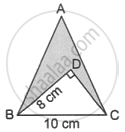
Figure shows an equilateral triangle ABC whose each side is 10 cm and a right-angled triangle BDC whose side BD = 8 cm and ∠D = 90°. Find the area of the shaded portion.
Advertisements
Solution
Given:
ABC is an equilateral triangle with side AB = BC = CA = 10 cm.
Triangle BDC is right-angled at D with BD = 8 cm and BC = 10 cm.
Step-wise calculation:
1. Use Pythagoras in right triangle BDC to find DC:
`DC = sqrt(BC^2 - BD^2)`
= `sqrt(10^2 - 8^2)`
= `sqrt(100 - 64)`
= `sqrt(36)`
= 6 cm
2. Area of equilateral triangle ABC (side a = 10):
Area (ABC) = `sqrt(3)/4 a^2`
= `sqrt(3)/4 xx 10^2`
= `25sqrt(3) cm^2`
3. Area of right triangle BDC (legs 6 and 8):
Area (BDC) = `1/2` × BD × DC
= `1/2 xx 8 xx 6`
= 24 cm2
4. Shaded area = Area (ABC) – Area (BDC)
= `25sqrt(3) - 24 cm^2`
= 25(1.73205) – 24
= 43.3013 – 24
= 19.3013 cm2
Shaded area = `25sqrt(3)` – 24 cm2 ≈ 19.30 cm2.
