Advertisements
Advertisements
Question
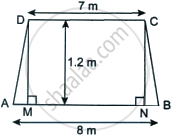
The cross-section of a tunnel perpendicular to its length is an isosceles trapezium as shown in the figure. If AB = 8 m, DC = 7 m, AD = BC and DM = 1.2 m and the tunnel is 100 m long, then calculate:
- the cost of painting the internal surface of the tunnel (excluding the floor) at the rate of ₹ 6 per m2.
- the cost of paving the floor at the rate of ₹ 20 per m2.
- the cubic content of the tunnel.
Advertisements
Solution
Given:
Cross-section is an isosceles trapezium with AB = 8 m (bottom), DC = 7 m (top), AD = BC, DM = height = 1.2 m. Tunnel length = 100 m.
Use: Volume = (area of cross-section) × length and lateral surface (excluding floor) = (sum of top + 2 side lengths) × length.
Step-wise calculation:
1. Find the slant side AD and BC.
Horizontal offset on each side
= `(AB - DC)/2`
= `(8 - 7)/2`
= 0.5 m
`AD = sqrt((0.5)^2 + (1.2)^2)`
= `sqrt(0.25 + 1.44)`
= `sqrt(1.69)`
= 1.3 m
2. Internal surface to be painted (excluding floor).
Per cross-section (top + 2 sides)
= DC + AD + BC
= 7 + 1.3 + 1.3
= 9.6 m
Painted area
= (9.6 m) × (length 100 m)
= 960 m2
Painting cost
= 960 × ₹ 6
= ₹ 5,760
3. Floor paving
Floor area
= AB × length
= 8 × 100
= 800 m2
Paving cost
= 800 × ₹ 20
= ₹ 16,000
4. Cubic content (volume).
Area of trapezium cross-section
= `1/2` × (AB + DC) × height
= 0.5 × (8 + 7) × 1.2
= 0.5 × 15 × 1.2
= 9.0 m2
Volume
= Area × Length
= 9.0 × 100
= 900 m3
- Cost of painting internal surface (excluding floor) = ₹ 5,760.
- Cost of paving the floor = ₹ 16,000.
- Cubic content (volume) of the tunnel = 900 m3.
