Advertisements
Advertisements
Question
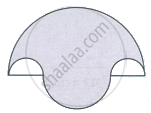
In the following figure, the boundary of the shaded region in the given diagram consists of four semi-circular arcs, the smallest two being equal. If the diameter of the largest is 14 cm and of the smallest is 3.5 cm, calculate:
- the length of the boundary,
- the area of the shaded region `("Take" π = 22/7)`.
Advertisements
Solution
Given:
Diameter of largest semicircle = 14 cm
⇒ Radius R = 7 cm
Diameter of each smallest semicircle = 3.5 cm
⇒ Radius r = 1.75 cm
`π = 22/7`
From the figure, the boundary consists of 4 semicircular arcs:
- One large semicircle (diameter 14 cm)
- Two small equal semicircles (diameter 3.5 cm each)
- One middle semicircle
Step 1: Find diameter of the middle semicircle
The total base equals the diameter of the largest semicircle:
14 = 3.5 + Middle diamater + 3.5
Middle diameter = 14 – 7 = 7 cm
So, middle semicircle radius = 3.5 cm
i. Length of the boundary
Length of a semicircle = πr
Large semicircle:
`πR = 22/7 xx 7`
= 22 cm
Middle semicircle:
`π xx 3.5 = 22/7 xx 3.5`
= 11 cm
Two small semicircles:
Each:
`π xx 1.75 = 22/7 xx 1.75`
= 5.5 cm
So two:
5.5 + 5.5 = 11 cm
Total boundary length:
22 + 11 + 11 = 44 cm
ii. Area of shaded region
Area of a semicircle = `1/2 πr^2`
Area of large semicircle:
`1/2 xx 22/7 xx 7^2`
= `1/2 xx 22/7 xx 49`
= 77 cm2
Area of middle semicircle:
`1/2 xx 22/7 xx (3.5)^2`
= `1/2 xx 22/7 xx 12.25`
= 19.25 cm2
Area of two small semicircles:
Each:
`1/2 xx 22/7 xx (1.75)^2`
= 4.8125 cm2
Two:
9.625 m2
Total shaded area:
77 + 19.25 – 9.625
= 86.625 cm2
