Topics
Number System (Including Estimation and Approximation)
Theme 1 : Numbers
Number System(Consolidating the Sense of Numberness)
Number System
Numbers in Indian and International Systems (With Comparison)
Estimation
Theme 2 : Ratio, Proportion and Arithmetic Problems
Ratio and Proportion
Algebra
Natural Numbers and Whole Numbers (Including Number Line and Patterns)
Theme 3 : Algebra
Numbers in India and International System (With Comparison)
Theme 4 : Geometry
Negative Numbers and Integers
Place Value
Geometry
Mensuration
Natural Numbers and Whole Numbers (Including Patterns)
Theme 5 : Mensuration
Sets
Data Handling
Negative Numbers and Integers
Fractions
Theme 6 : Statistics
Decimal Fractions
Number Line
HCF and LCM
Playing with Numbers (Including H.C.F. and L.C.M.)
Ratio and Proportion (Including Unitary Method)
Playing with Numbers
- Simplification of Brackets
- Finding Factors Using Rectangular Arrangements and Division
- Factors and Common Factors
- Multiples and Common Multiples
- Concept of Even and Odd Number
- Tests for Divisibility of Numbers
- Divisibility by 2
- Divisibility by 4
- Divisibility by 8
- Divisibility by 3
- Divisibility by 6
- Divisibility by 9
- Divisibility by 5
- Divisibility by 11
Sets
Percent (Percentage)
Ratio
Idea of Speed, Distance and Time
Fundamental Concepts (With operations on Algebraic Expressions)
Proportion (Including Word Problems)
Framing Algebraic Expressions (Including Substitution and Linear Equations)
Unitary Method
Fractions
- Concept of Fraction
- Types of Fractions
- Concept of Proper and Improper Fractions
- Concept of Mixed Fractions
- Like and Unlike Fraction
- Concept of Equivalent Fractions
- Conversion between Improper and Mixed fraction
- Conversion between Unlike and Like Fractions
- Simplest Form of a Fractions
- Comparing Fractions
- Addition of Fraction
- Subtraction of Fraction
- Multiplication of Fraction
- Division of Fractions
- Using Operator 'Of' with Multiplication and Division
- BODMAS Rule
- Problems Based on Fraction
Fundamental Concepts (Including Angles and their Properties)
Triangles (Including Types and Properties of Triangles)
Decimal Fractions
Percent (Percentage)
Quadrilaterals
Idea of Speed, Distance and Time
Circles
Constructions
Symmetry
Fundamental Concepts
Fundamental Operations (Related to Algebraic Expressions)
Recognition of Solids
Substitution (Including Use of Brackets as Grouping Symbols)
Perimeter and Area of Plane Figures
Framing Algebraic Expressions (Including Evaluation)
Data Handling (Including Mean and Median)
Simple (Linear) Equations (Including Word Problems)
Fundamental Concepts
Angles (With Their Types)
Properties of Angles and Lines (Including Parallel Lines)
Triangles (Including Types, Properties and Constructions)
Quadrilateral
Polygons
The Circle
Symmetry (Including Constructions on Symmetry)
Recognition of Solids
Perimeter and Area of Plane Figures
Data Handling (Including Pictograph and Bar Graph)
Mean and Median
- Introduction
- Rounding Off a Number to the Nearest Ten
- Rounding Off a Number to the Nearest Hundred
- Rounding Off a Number to the Nearest Thousand
- Examples
- Real-Life Application
- Key Rules Summary
CISCE: Class 6
Introduction
Imagine seeing a shirt priced at ₹487—should you think of it as ₹480 or ₹490? When making quick budget decisions, giving change, or estimating a crowd, rounding helps you get close answers without counting every single unit!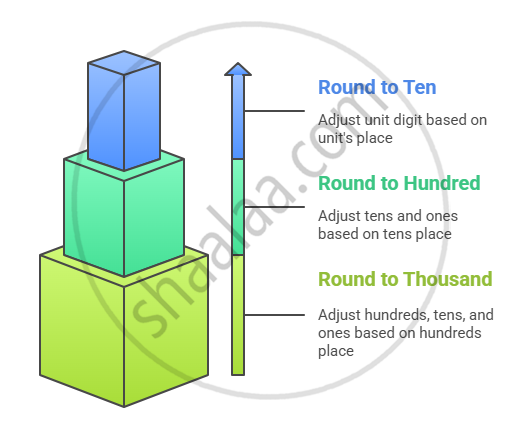
CISCE: Class 6
Rounding Off a Number to the Nearest Ten
Steps:
- See the digit at the unit's (ones) place.
- If it’s less than 5, change it to 0.
- If it’s 5 or more, make it 0 and add 1 to the tens digit.
Example:
- 542 → ones digit is 2 (< 5) → 540
- 586 → ones digit is 6 (≥ 5) → 590
- 455 → ones digit is 5 → 460
CISCE: Class 6
Rounding Off a Number to the Nearest Hundred
Steps:
- See the digit in the tens place of the given number.
- If it’s less than 5, change the tens and ones digits to 0.
- If it’s 5 or more, change the tens and, ones digits to 0 and add 1 to the hundreds digit.
Example:
- 549 → tens is 4 (< 5) → 500
- 564 → tens is 6 (≥ 5) → 600
- 852 → tens is 5 → 900
CISCE: Class 6
Rounding Off a Number to the Nearest Thousand
Steps:
- See the digit in the hundreds place of the given number.
- If it’s less than 5, change the hundreds, tens, and ones digits to 0.
- If it’s 5 or more, change the hundreds, tens, and ones digits to 0 and add 1 to the thousands digit.
Example:
- 2394 → hundreds is 3 (< 5) → 2000
- 5432 → hundreds is 4 (< 5) → 5000
- 5629 → hundreds is 6 (≥ 5) → 6000
- 7536 → hundreds is 5 → 8000
CISCE: Class 6
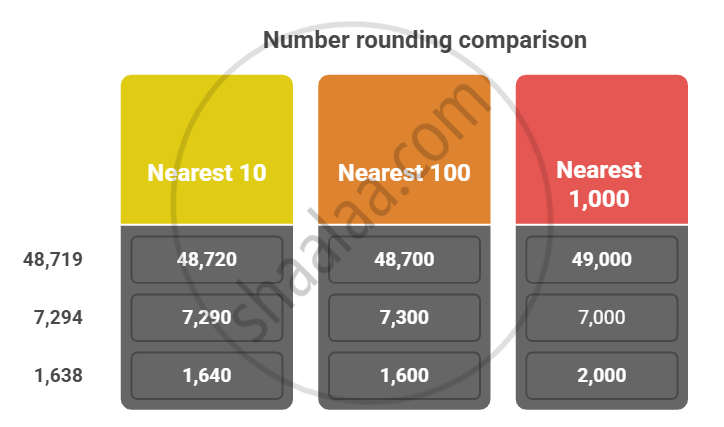
Examples
CISCE: Class 6
Real-Life Application
1. Estimating a Crowd:
"About 51,000 spectators" might mean 50,800 or 51,300, but rounding gives a fair estimate for quick planning.
2. Shopping:
Three items priced at ₹378, ₹422, and ₹239.
- Rounded: 380, 420, 240
- Quick total: 380 + 420 + 240 = ₹1,040
3. Sharing Money:
A trader receives ₹13,569 and ₹26,785.
- Rounds: 14,000 + 27,000 = 41,000
- Total estimate: ₹41,000
CISCE: Class 6
Key Rules Summary
5 or more: round up!
4 or less: round down!
Rounding steps:
- Find the digit of the place you want to round to.
- Check the digit just to the right of it.
- Round up if that digit is 5 or more; otherwise, round down.
Test Yourself
Video Tutorials
Shaalaa.com | Why Do We Round Off Numbers & How to Round Off Numbers?
to track your progress
