Topics
Rational Numbers
- Rational Numbers
- Addition of Rational Number
- Subtraction of Rational Number
- Multiplication of Rational Numbers
- Division of Rational Numbers
- Rational Numbers on a Number Line
- Inserting Rational Numbers Between Two Given Rational Numbers
- Method of Finding a Large Number of Rational Numbers Between Two Given Rational Numbers
Number System
Ratio and Proportion
Exponents
- Concept of Exponents
- Law of Exponents (For Integral Powers)
- Negative Integral Exponents
- More About Exponents
Squares and Square Root
- Concept of Square Roots
- Finding Square Root by Division Method
- Finding Square Root Through Prime Factorisation
- To Find the Square Root of a Number Which is Not a Perfect Square (Using Division Method)
- Properties of Square Numbers
Algebra
Cubes and Cube Roots
Geometry
Mensuration
Playing with Numbers
- Arranging the Objects in Rows and Columns
- Generalized Form of Numbers
- Some Interesting Properties
- Letters for Digits (Cryptarithms)
- Divisibility by 10
- Divisibility by 2
- Divisibility by 5
- Divisibility by 3
- Divisibility by 6
- Divisibility by 11
- Divisibility by 4
Sets
- Concept of Sets
- Representation of a Set
- Cardinality of a Set
- Types of Sets
- Subset
- Proper Subset
- Super Set
- Universal Set
- Complement of a Set
- Difference of Two Sets
- Distributive Laws
- Venn Diagrams
Data Handling (Statistics)
Percent and Percentage
Profit, Loss and Discount
- Overhead Expenses
- To Find S.P., When C.P. and Gain (Or Loss) Percent Are Given
- To Find C.P., When S.P. and Gain (Or Loss) Percent Are Given
- Concept of Discount
Interest
- Calculation of Interest
- Concept of Compound Interest
- To Find the Principle (P); the Rate Percent (R) and the Time
- Interest Compounded Half Yearly
- Applications of Compound Interest Formula
Direct and Inverse Variations
- Types of Variation
- Unitary Method
- Concept of Arrow Method
- Time and Work
Algebraic Expressions
- Algebraic Expressions
- Degree of Polynomial
- Factors and Common Factors
- Classification of Terms in Algebra
- Combining like Terms
- Multiplying Monomial by Monomials
- Multiplying a Monomial by a Polynomial
- Multiplying a Polynomial by a Polynomial
- Dividing a Monomial by a Monomial
- Dividing a Polynomial by a Monomial
- Dividing a Polynomial by a Polynomial
- Simplification of Expressions
Identities
- Algebraic Identities
- Product of Sum and Difference of Two Terms
- Expansion Form of Numbers
- Important Formula of Expansion
- Cubes of Binomials
- Application of Formulae
Factorisation
- Factorisation by Taking Out Common Factors
- Factorisation by Taking Out Common Factors
- Factorisation by Grouping
- Factorisation by Difference of Two Squares
- Factorisation of Trinomials
- Factorising a Perfect Square Trinomial
- Factorising Completely
Linear Equations in One Variable
Linear Inequations
- Pair of Linear Equations in Two Variables
- Replacement Set and Solution Set
- Operation of Whole Numbers on Number Line
- Concept of Properties
Understanding Shapes
Special Types of Quadrilaterals
Constructions
- Introduction of Constructions
- Construction of an Angle
- To Construct an Angle Equal to Given Angle
- To Draw the Bisector of a Given Angle
- Construction of an Angle Bisector: 30°, 45°, 60°, 90°
- Construction of Bisector of a Line
- The Perpendicular Bisector
- Construction of Parallel Lines
- Constructing a Quadrilateral
- Construction of Parallelograms
- Construction of a Rectangle When Its Length and Breadth Are Given.
- Construction of Rhombus
- Square: Properties and Construction
- Reflection Symmetry (Mirror Symmetry)
Representing 3-D in 2-D
- 2dimensional Perspective of 3dimensional Objects
- Concept of Polyhedron
- Faces, Edges and Vertices of Polyhedron
- Euler's Formula
- Concept of Polyhedron
- Nets of 3D Figures
Symmetry
Circles
Area of a Trapezium and a Polygon
Surface Area, Volume and Capacity
Data Handling
- Mathematical Data Collection and Organisation
- Frequency
- Raw Data, Arrayed Data and Frequency Distribution
- Cumulative Frequency and Cumulative Frequency Table
- Frequency Distribution Table
- Class Intervals and Class Limits
- Frequency Distribution and Its Applications
Probability
- Definition: Direct Variation
- Definition: Inverse Variation
- Example 1
- Example 2
- Example 3
- Example 4
- Key Points Summary
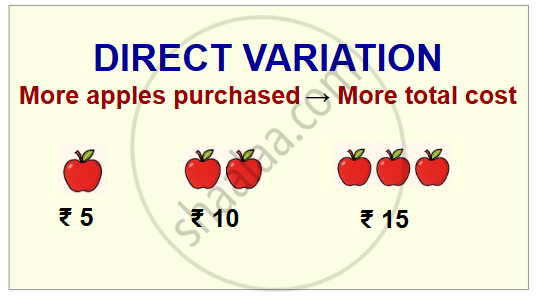
Definition: Direct Variation
Two quantities are said to have direct variation if, when one quantity increases, the other quantity also increases, and when one quantity decreases, the other quantity also decreases.
Definition: Inverse Variation
Two quantities are in inverse variation if, when one quantity increases, the other decreases, and when one decreases, the other increases.

Example 1
A car, running with uniform speed, covers a distance of 96 km in 3 hours. How much distance will the car cover in 5 hours, running at the same speed?
Solution:
In 3 hours, car covers 96 km
⇒ In 1 hour, car covers
96 In 1 hour, car covers `96/3` km = 32 km
And, in 5 hours, car covers = 32 km × 5 = 160 km.
Example 2
A car can travel 360 km, consuming 24 litres of petrol. How much petrol will it consume while travelling a distance of 480 km?
Solution:
Car can travel 360 km, consuming 24 litres of petrol.
⇒ Car can travel 1 km consuming `24/360` litres of petrol.
And the car can travel 480 km, consuming `24/360` × 480 litres of petrol.
= 32 litres of petrol
Example 3
A car covers a distance of 30 km, consuming 2 litres of petrol, whereas a motorcycle covers a distance of 90 km, consuming 1.2 litres of petrol.
- How much distance will each cover after consuming 3 litres of petrol?
- Which of these two will cover more distance (each consuming 3 litres of petrol), and by how much?
Solution:
(i) Consuming 2 liters of petrol, the car covers 30 km
⇒ Consuming 1 liter of petrol, the car covers `30/2` km = 15km
And, consuming 3 litres of petrol, the car covers 15 km × 3 = 45 km.
Now, consuming 1.2 litres of petrol, the motorcycle covers 90 km.
⇒ Consuming 1 liter of petrol, motorcycle covers `90/1.2` km = 75 km.
And, consuming 3 litres of petrol, motorcycle covers 75 × 3 km = 225 km
(ii) Motorcycle covers more distance, by 225 km - 45 km = 180 km
Example 4
The number of men and the number of days taken by them to complete certain work. Clearly, if the number of men is more (increased), the number of days taken by them to complete the same work is less (decreased). And, if the number of men is less (decreased), the number of days taken by them to complete the same work is more (increased).
Explanation:
-
Inverse Relationship
-
More Men → Fewer Days
-
Fewer Men → More Days
-
Total Work Remains Constant
Key Points Summary
-
Variation: When two things change together
-
Direct Variation: Both go up or down together
-
Inverse Variation: One goes up, the other goes down
-
Constant: Fixed number in a formula
Test Yourself
Related QuestionsVIEW ALL [6]
In which of the following table, x and y vary directly:
| x | 3 | 5 | 8 | 11 |
| y | 4.5 | 7.5 | 12 | 16.5 |
In which of the following table, x and y vary directly:
| x | 27 | 45 | 54 | 75 |
| y | 81 | 180 | 216 | 225 |
Check whether x and y vary inversely or not.
| x | 4 | 3 | 12 | 1 |
| y | 6 | 8 | 2 | 24 |
Check whether x and y vary inversely or not.
| x | 30 | 120 | 60 | 24 |
| y | 60 | 30 | 30 | 75 |
In which of the following table, x and y vary directly:
| x | 16 | 30 | 40 | 56 |
| y | 32 | 60 | 80 | 84 |
Check whether x and y vary inversely or not.
| x | 10 | 30 | 60 | 10 |
| y | 90 | 30 | 20 | 90 |
