Topics
Number System
Number System(Consolidating the Sense of Numberness)
Theme 1 : Numbers
Number System (Including Estimation and Approximation)
Estimation
Theme 2 : Ratio, Proportion and Arithmetic Problems
Numbers in Indian and International Systems (With Comparison)
Ratio and Proportion
Theme 3 : Algebra
Algebra
Numbers in India and International System (With Comparison)
Natural Numbers and Whole Numbers (Including Number Line and Patterns)
Negative Numbers and Integers
Place Value
Theme 4 : Geometry
Geometry
Sets
Theme 5 : Mensuration
Mensuration
Natural Numbers and Whole Numbers (Including Patterns)
Fractions
Theme 6 : Statistics
Data Handling
Negative Numbers and Integers
Decimal Fractions
Number Line
Playing with Numbers (Including H.C.F. and L.C.M.)
HCF and LCM
Playing with Numbers
- Simplification of Brackets
- Finding Factors Using Rectangular Arrangements and Division
- Factors and Common Factors
- Multiples and Common Multiples
- Concept of Even and Odd Number
- Tests for Divisibility of Numbers
- Divisibility by 2
- Divisibility by 4
- Divisibility by 8
- Divisibility by 3
- Divisibility by 6
- Divisibility by 9
- Divisibility by 5
- Divisibility by 11
Ratio and Proportion (Including Unitary Method)
Sets
Percent (Percentage)
Ratio
Idea of Speed, Distance and Time
Proportion (Including Word Problems)
Fundamental Concepts (With operations on Algebraic Expressions)
Unitary Method
Framing Algebraic Expressions (Including Substitution and Linear Equations)
Fundamental Concepts (Including Angles and their Properties)
Fractions
- Concept of Fraction
- Types of Fractions
- Concept of Proper and Improper Fractions
- Concept of Mixed Fractions
- Like and Unlike Fraction
- Concept of Equivalent Fractions
- Conversion between Improper and Mixed fraction
- Conversion between Unlike and Like Fractions
- Simplest Form of a Fractions
- Comparing Fractions
- Addition of Fraction
- Subtraction of Fraction
- Multiplication of Fraction
- Division of Fractions
- Using Operator 'Of' with Multiplication and Division
- BODMAS Rule
- Problems Based on Fraction
Triangles (Including Types and Properties of Triangles)
Decimal Fractions
Percent (Percentage)
Quadrilaterals
Idea of Speed, Distance and Time
Circles
Constructions
Symmetry
Fundamental Concepts
Fundamental Operations (Related to Algebraic Expressions)
Substitution (Including Use of Brackets as Grouping Symbols)
Recognition of Solids
Perimeter and Area of Plane Figures
Framing Algebraic Expressions (Including Evaluation)
Data Handling (Including Mean and Median)
Simple (Linear) Equations (Including Word Problems)
Fundamental Concepts
Angles (With Their Types)
Properties of Angles and Lines (Including Parallel Lines)
Triangles (Including Types, Properties and Constructions)
Quadrilateral
Polygons
The Circle
Symmetry (Including Constructions on Symmetry)
Recognition of Solids
Perimeter and Area of Plane Figures
Data Handling (Including Pictograph and Bar Graph)
Mean and Median
- Introduction
- Reading and Writing Large Numbers Using the Hindu-Arabic System
- Examples
- Real-Life Application
- Tips, Tricks, and Common Mistakes
Introduction
Whenever you see a six-digit cheque amount, read India’s population, or hear about a winning lottery, you’re seeing the Hindu-Arabic (Indian) System in action. It helps us make sense of large numbers in daily life!
-
10 Digit: Uses symbols 0, 1, 2, 3, 4, 5, 6, 7, 8, 9.
-
Base-10 System: Each place’s value increases tenfold as you move left.
-
Place Value: The value of each digit depends on its position (ones, tens, hundreds, etc.).
-
Zero as Placeholder: Allows for representation of any number, large or small.
-
Origin: Developed in India and spread by Arab scholars.
Reading and Writing Large Numbers Using the Hindu-Arabic System
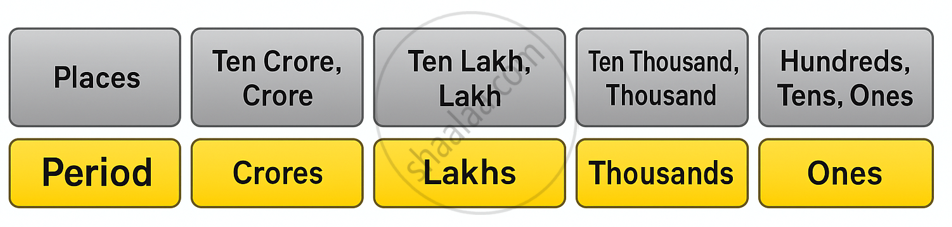
In the Indian System, also called the Hindu-Arabic System, to read and write large quantities with ease, the groups are made with certain periods, as shown below:
| Value | 10,00,00,000 | 1,00,00,000 | 10,00,000 | 1,00,000 | 10,000 | 1,000 | 100 | 10 | 1 |
| Period | Ten crore (TC) | Crore (C) |
Ten Lakhs (T L) |
Lakh (L) |
Ten Thousand (T Th) |
Thousand (Th) |
Hundreds (H) |
Tens (T) |
Ones (O) |
Reading and Writing Large Numbers Using the Hindu-Arabic System:
| Periods → |
Crores | Lakhs | Thousands | Ones | |||||
| ↓ Numbers | (TC) | (C) | (TL) |
L |
(TTh) | (Th) | (H) | (T) | (O) |
| 7456123 | 7 | 4 | 5 | 6 | 1 | 2 | 3 | ||
| 225437 |
|
|
2 | 2 | 5 | 4 | 3 | 7 | |
| 61786425 |
|
6 |
1 | 7 | 8 | 6 | 4 | 2 | 5 |
| 82854137 |
|
8 |
2 | 8 | 5 | 4 | 1 | 3 | 7 |
| 743813256 | 7 | 4 | 3 | 8 | 1 | 3 | 2 | 5 | 6 |
Examples
- 7456123 = 74,56,123
= Seventy-four lakh fifty-six thousand one hundred twenty-three. - 82854137 = 8,28,54,137
= Eight crore twenty-eight lakh fifty-four thousand one hundred thirty-seven. - 61786425 = 6,17,86,425
= Six crore seventeen lakh eighty-six thousand four hundred twenty-five. - 82854137 = 8,28,54, 137
= Eight crore twenty-eight lakh fifty-four thousand one hundred thirty-seven. - 743813256 = 74,38,13,256
= Seventy-four crore thirty-eight lakh thirteen thousand two hundred fifty-six.
Note:
-
Don’t use plurals when writing numbers in words (e.g., write five thousand, not five thousands).
-
Don’t use “and” between tens and ones in number words (e.g., write five hundred ninety-three, not five hundred and ninety-three).
-
Don’t use commas when writing numerals like 2,468. Instead, write Two thousand four hundred sixty-eight.
Real-Life Application
1. A check for ₹23,45,678 is written as
- 23,45,678 (figures)
- Twenty-three lakh forty-five thousand six hundred seventy-eight (in words)
2. Population data: “1,38,00,00,000” is spoken as “one hundred thirty-eight crore.”
Tips, Tricks, and Common Mistakes
- Commas: Always write from the right: first three digits, then every two digits.
- No “and” in words. Don’t use “and” (e.g., NOT “two hundred and fifty”).
- No plurals: Use “lakh”, not “lakhs.”
- Commas only in figures, not in words.
- Zero is never at the start (e.g., “07,21,096” is just “7,21,096”).
