Topics
Part 1
Integers
- Natural Numbers
- Whole Numbers
- Negative and Positive Numbers
- Integers
- Representation of Integers on the Number Line
- Ordering of Integers
- Addition of Integers
- Subtraction of Integers
- Properties of Addition and Subtraction of Integers
- Multiplication of a Positive and a Negative Integers
- Multiplication of Two Negative Integers
- Product of Three Or More Negative Integers
- Closure Property of Multiplication of Integers
- Commutative Property of Multiplication of Integers
- Multiplication of Integers with Zero
- Multiplicative Identity of Integers
- Associative Property of Multiplication of Integers
- Distributive Property of Multiplication of Integers
- Making Multiplication Easier of Integers
- Division of Integers
- Properties of Division of Integers
Large Numbers Around Us
Part 2
Arithmetic Expressions
Fractions and Decimals
- Concept of Fraction
- Types of Fractions
- Concept of Proper and Improper Fractions
- Concept of Mixed Fractions
- Concept of Equivalent Fractions
- Like and Unlike Fraction
- Comparing Fractions
- Addition of Fraction
- Subtraction of Fraction
- Multiplication of a Fraction by a Whole Number
- Using Operator 'Of' with Multiplication and Division
- Multiplication of Fraction
- Division of Fractions
- Concept of Reciprocals or Multiplicative Inverses
- Problems Based on Fraction
- The Decimal Number System
- Comparing Decimal Numbers
- Addition of Decimal Fraction
- Subtraction of Decimal Numbers
- Multiplication of Decimal Numbers
- Division of Decimal Numbers
- Problems Based on Decimal Numbers
A Peek Beyond the Point
Data Handling
Expressions using Letter-Numbers
Simple Equations
Lines and Angles
Parallel and Intersecting Lines
The Triangle and Its Properties
- Basic Concepts of Triangles
- Classification of Triangles based on Sides
- Classification of Triangles based on Angles
- Median of a Triangle
- Altitudes of a Triangle
- Exterior Angle of a Triangle and Its Property
- Some Special Types of Triangles - Equilateral and Isosceles Triangles
- Basic Properties of a Triangle
- Right-angled Triangles and Pythagoras Property
Number Play
Congruence of Triangles
- Similarity and Congruency of Figures
- Congruence Among Line Segments
- Congruence of Angles
- Congruence of Triangles
- Criteria for Congruence of Triangles
- Criteria for Similarity of Triangles
- SAS Congruence Criterion
- ASA Congruence Criterion
- RHS Congruence Criterion
- Exceptional Criteria for Congruence of Triangles
A Tale of Three Intersecting Lines
Comparing Quantities
- Ratio
- Concept of Equivalent Ratios
- Proportion
- Unitary Method
- Basic Concept of Percentage
- Estimation in Percentages
- Interpreting Percentages
- Conversion between Percentage and Fraction or Decimal
- Ratios to Percents
- Increase Or Decrease as Percent
- Basic Concepts of Profit and Loss
- Profit or Loss as a Percentage
- Calculation of Interest
Working with Fractions
Rational Numbers
- Rational Numbers
- Equivalent Rational Number
- Positive and Negative Rational Numbers
- Rational Numbers on a Number Line
- Rational Numbers in Standard Form
- Comparison of Rational Numbers
- Rational Numbers Between Two Rational Numbers
- Addition of Rational Number
- Subtraction of Rational Number
- Multiplication of Rational Numbers
- Division of Rational Numbers
Geometric Twins
Perimeter and Area
- Basic Concepts in Mensuration
- Concept of Perimeter
- Perimeter of a Rectangle
- Perimeter of Squares
- Perimeter of Triangle
- Perimeter of Polygon
- Concept of Area
- Area of Square
- Area of Rectangle
- Triangles as Parts of Rectangles and Square
- Generalising for Other Congruent Parts of Rectangles
- Area of a Parallelogram
- Area of a Triangle
- Circumference of a Circle
- Area of Circle
- Conversion of Units
- Problems based on Perimeter
- Problems based on Area
Algebraic Expressions
Operations with Integers
Practical Geometry
- Construction of a Line Parallel to a Given Line, Through a Point Not on the Line
- Construction of Triangles
- Constructing a Triangle When the Length of Its Three Sides Are Known (SSS Criterion)
- Constructing a Triangle When the Lengths of Two Sides and the Measure of the Angle Between Them Are Known. (SAS Criterion)
- Constructing a Triangle When the Measures of Two of Its Angles and the Length of the Side Included Between Them is Given. (ASA Criterion)
- Constructing a Right-angled Triangle When the Length of One Leg and Its Hypotenuse Are Given (RHS Criterion)
Exponents and Powers
- Concept of Exponents
- Multiplying Powers with the Same Base
- Dividing Powers with the Same Base
- Taking Power of a Power
- Multiplying Powers with Different Base and Same Exponents
- Dividing Powers with Different Base and Same Exponents
- Numbers with Exponent Zero, One, Negative Exponents
- Miscellaneous Examples Using the Laws of Exponents
- Decimal Number System Using Exponents and Powers
- Crores
Finding Common Ground
Symmetry
Another Peek Beyond the Point
Connecting the Dots
Visualizing Solid Shapes
Constructions and Tilings
Finding the Unknown
- Introduction
- Definition: Symmetry
- Definition: Line of Symmetry
- Activity 1
- Activity 2
- Key Points Summary
Introduction
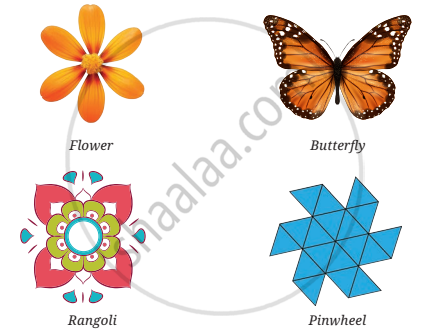
Look around you. Your face is nearly identical on both sides. A butterfly's wings match perfectly. The Taj Mahal looks the same from the left and right. These are all examples of symmetry – one of nature's most beautiful patterns.
Symmetry isn't just about appearance. It helps us:
-
Design buildings and bridges that look balanced and stand strong
-
Create art and patterns that please our eyes
-
Understand nature – from tiny snowflakes to giant trees
-
Solve geometry problems more easily

Definition: Symmetry
Symmetry means that one half of an object is an exact mirror image of the other half. If you could fold the object and both halves match perfectly, then it has symmetry.
-
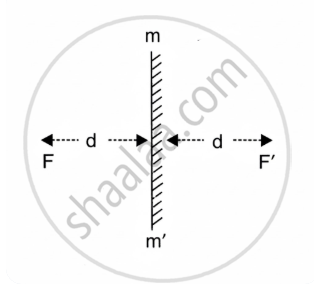
Mirror line mm′ = Line of Symmetry
-
Object (F) and its image (F′) are equal distances from the line
-
When folded along this line, both parts match exactly
Definition: Line of Symmetry
A line of symmetry is an imaginary line that divides a shape into two identical halves. Each half is the mirror image of the other.
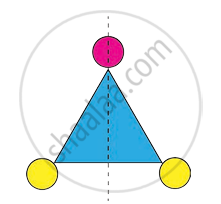
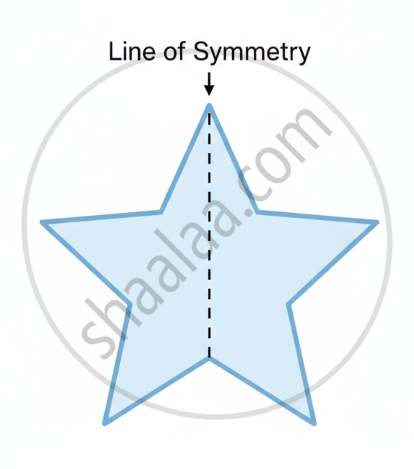
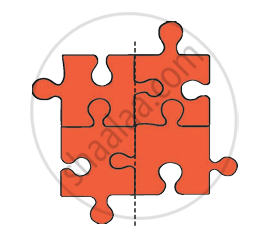
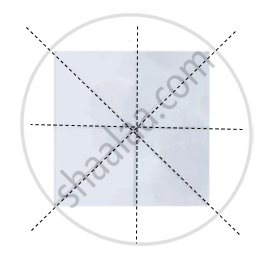
Some shapes, like a square, have more than one line of symmetry.
Activity 1
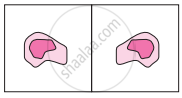
Colour Blob Fold:
Steps:
- Take a sheet of paper and fold it in half, then unfold it.
- Put a blob of paint or colour on one side of the fold.
- Fold the paper again and press gently.
- Unfold the paper and look at the shape formed.
Observation:
- The paint spreads to the other side of the fold.
- The shape on both sides of the fold looks exactly the same.
- Both sides appear like mirror images.
Conclusion:
- The shape formed is symmetrical.
- The folded line acts as a symmetry line.
- This activity shows how symmetry creates balance and equality in shape.
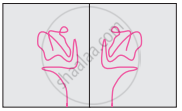
Activity 2
Thread Painting:
Steps:
- Take a sheet of paper and a thread dipped in colour.
- Place the coloured threads on one side of the paper.
- Fold the paper over the thread.
- Press the folded paper gently and then pull the thread out from one end.
- Unfold the paper and observe the pattern formed.
Observation:
- A colourful, creative shape appears on the paper.
- The design on both sides of the fold looks similar.
- The two halves are mirror images of each other.
Conclusion:
- The pattern formed is symmetrical.
- The fold line acts as a symmetry line.
- This activity demonstrates how symmetry can be created through movement and colour.
Key Points Summary
| Concept | Definition | Example |
|---|---|---|
| Symmetry | When an object can be divided into two identical mirror halves. | Butterfly wings |
| Line of Symmetry | The imaginary line that divides a shape into mirror images. | Vertical line through a heart |