Topics
Integers
- Natural Numbers
- Whole Numbers
- Negative and Positive Numbers
- Integers
- Representation of Integers on the Number Line
- Ordering of Integers
- Addition of Integers
- Subtraction of Integers
- Properties of Addition and Subtraction of Integers
- Multiplication of a Positive and a Negative Integers
- Multiplication of Two Negative Integers
- Product of Three Or More Negative Integers
- Closure Property of Multiplication of Integers
- Commutative Property of Multiplication of Integers
- Multiplication of Integers with Zero
- Multiplicative Identity of Integers
- Associative Property of Multiplication of Integers
- Distributive Property of Multiplication of Integers
- Making Multiplication Easier of Integers
- Division of Integers
- Properties of Division of Integers
Part 1
Large Numbers Around Us
Arithmetic Expressions
Fractions and Decimals
- Concept of Fraction
- Types of Fractions
- Concept of Proper and Improper Fractions
- Concept of Mixed Fractions
- Concept of Equivalent Fractions
- Like and Unlike Fraction
- Comparing Fractions
- Addition of Fraction
- Subtraction of Fraction
- Multiplication of a Fraction by a Whole Number
- Using Operator 'Of' with Multiplication and Division
- Multiplication of Fraction
- Division of Fractions
- Concept of Reciprocals or Multiplicative Inverses
- Problems Based on Fraction
- The Decimal Number System
- Comparing Decimal Numbers
- Addition of Decimal Fraction
- Subtraction of Decimal Numbers
- Multiplication of Decimal Numbers
- Division of Decimal Numbers
- Problems Based on Decimal Numbers
Part 2
A Peek Beyond the Point
Data Handling
Simple Equations
Expressions using Letter-Numbers
Lines and Angles
Parallel and Intersecting Lines
Number Play
The Triangle and Its Properties
- Basic Concepts of Triangles
- Classification of Triangles based on Sides
- Classification of Triangles based on Angles
- Median of a Triangle
- Altitudes of a Triangle
- Exterior Angle of a Triangle and Its Property
- Some Special Types of Triangles - Equilateral and Isosceles Triangles
- Basic Properties of a Triangle
- Right-angled Triangles and Pythagoras Property
A Tale of Three Intersecting Lines
Comparing Quantities
- Ratio
- Concept of Equivalent Ratios
- Proportion
- Unitary Method
- Basic Concept of Percentage
- Estimation in Percentages
- Interpreting Percentages
- Conversion between Percentage and Fraction or Decimal
- Ratios to Percents
- Increase Or Decrease as Percent
- Basic Concepts of Profit and Loss
- Profit or Loss as a Percentage
- Calculation of Interest
Congruence of Triangles
- Similarity and Congruency of Figures
- Congruence Among Line Segments
- Congruence of Angles
- Congruence of Triangles
- Criteria for Congruence of Triangles
- Criteria for Similarity of Triangles
- SAS Congruence Criterion
- ASA Congruence Criterion
- RHS Congruence Criterion
- Exceptional Criteria for Congruence of Triangles
Working with Fractions
Rational Numbers
- Rational Numbers
- Equivalent Rational Number
- Positive and Negative Rational Numbers
- Rational Numbers on a Number Line
- Rational Numbers in Standard Form
- Comparison of Rational Numbers
- Rational Numbers Between Two Rational Numbers
- Addition of Rational Number
- Subtraction of Rational Number
- Multiplication of Rational Numbers
- Division of Rational Numbers
Perimeter and Area
- Basic Concepts in Mensuration
- Concept of Perimeter
- Perimeter of a Rectangle
- Perimeter of Squares
- Perimeter of Triangle
- Perimeter of Polygon
- Concept of Area
- Area of Square
- Area of Rectangle
- Triangles as Parts of Rectangles and Square
- Generalising for Other Congruent Parts of Rectangles
- Area of a Parallelogram
- Area of a Triangle
- Circumference of a Circle
- Area of Circle
- Conversion of Units
- Problems based on Perimeter
- Problems based on Area
Geometric Twins
Operations with Integers
Algebraic Expressions
Practical Geometry
- Construction of a Line Parallel to a Given Line, Through a Point Not on the Line
- Construction of Triangles
- Constructing a Triangle When the Length of Its Three Sides Are Known (SSS Criterion)
- Constructing a Triangle When the Lengths of Two Sides and the Measure of the Angle Between Them Are Known. (SAS Criterion)
- Constructing a Triangle When the Measures of Two of Its Angles and the Length of the Side Included Between Them is Given. (ASA Criterion)
- Constructing a Right-angled Triangle When the Length of One Leg and Its Hypotenuse Are Given (RHS Criterion)
Exponents and Powers
- Concept of Exponents
- Multiplying Powers with the Same Base
- Dividing Powers with the Same Base
- Taking Power of a Power
- Multiplying Powers with Different Base and Same Exponents
- Dividing Powers with Different Base and Same Exponents
- Numbers with Exponent Zero, One, Negative Exponents
- Miscellaneous Examples Using the Laws of Exponents
- Decimal Number System Using Exponents and Powers
- Crores
Finding Common Ground
Symmetry
Another Peek Beyond the Point
Connecting the Dots
Visualizing Solid Shapes
Constructions and Tilings
Finding the Unknown
Circumference of a Circle
The circumference, or the perimeter, of a circle, refers to the measurement of the border across any 2D circular shape, including the circle. 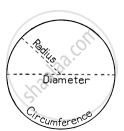
Formula: `"Circumference"/"diameter"` = π
circumference = π × diameter
= π × 2r (where r is the radius of the circle)
= 2πr
Circumference of a circle: 2πr
Example
What is the circumference of a circle of diameter 10 cm (Take π = 3.14)?
Diameter of the circle (d) = 10 cm
Circumference of circle = πd
= 3.14 × 10 cm
= 31.4 cm
So, the circumference of the circle of diameter 10 cm is 31.4 cm.
Example
Find the perimeter of the given shape (Take π = `22/7`).
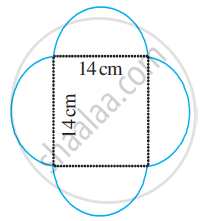
The outer boundary, of this figure, is made up of semicircles.
Diameter of each semicircle is 14 cm.
We know that:
Circumference of the circle = πd
Circumference of the semicircle = `1/2`πd
= `1/2 xx 22/7` × 14 cm
= 22 cm
Circumference of each of the semicircles is 22 cm
Therefore, perimeter of the given figure = 4 × 22 cm = 88 cm.
Example
Sudhanshu divides a circular disc of radius 7 cm in two equal parts. What is the perimeter of each semicircular shape disc? (Use π = `22/7`)
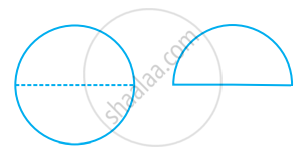
Given that radius (r) = 7 cm.
We know that the circumference of circle = 2πr
So, the circumference of the semicircle = `1/2` × 2πr = πr
= `22/7` × 7 cm
= 22 cm
So, the diameter of the circle =2r = 2 × 7 cm = 14 cm
Thus, perimeter of each semicircular disc = 22 cm + 14 cm = 36 cm.
Example
The radius of a circular plot is 7.7 metres. How much will it cost to fence the plot with 3 rounds of wire at the rate of 50 rupees per metre?
Circumference of circular plot = 2πr = `2 xx 22/7 xx 7.7` = 48.4
Length of wire required for one round of fencing = 48.4 m.
Cost of one round of fence = length of wire × cost per metre.
= 48.4 × 50
= 2420 rupees.
Cost of 3 rounds of fencing = 3 × 2420 = 7260 rupees
Example
The radius of the wheel of a bus is 0.7 m. How many rotations will a wheel complete while traveling a distance of 22 km?
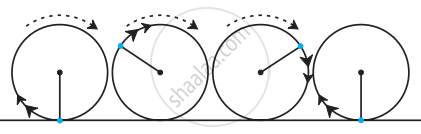
Circumference of circle = πd = `22/7` × 1.4 = 4.4 m
When the wheel completes one rotation it crosses a distance of 4.4 m., (1 rotation = 1 circumference)
Total number of rotations = `"distance"/"circumference"`
= `(22000)/(4.4)`
= `(220000)/(44)`
= 5000
A wheel completes 10,000 rotations to cover a distance of 22 km.
Video Tutorials
Shaalaa.com | Area Related to Circles part 6 (Example)
Series: 1
00:08:19 undefined
00:09:33 undefined
00:11:30 undefined
00:10:24 undefined
00:09:09 undefined
00:11:57 undefined
00:09:48 undefined
00:11:57 undefined
00:10:40 undefined
