Topics
Orienting Yourself: The Use of Coordinates
Number Systems
Number Systems
Part 1
Introduction to Polynomials
Introduction to Linear Polynomials
Part 2
Algebra
Algebraic Expressions
Algebraic Identities
Coordinate Geometry
The World of Numbers
Sequences and Progressions
Geometry
Exploring Algebraic Identities
Exploring Algebraic Identities
Area
Constructions
- Introduction of Constructions
- Geometric Constructions
- Some Constructions of Triangles
I’m Up and Down, and Round and Round
Mensuration
Linear Equations in Two Variables
Statistics and Probability
Measuring Space: Perimeter and Area
Coordinate Geometry
Probability
Introduction to Euclid’s Geometry: Axioms and Postulates
The Mathematics of Maybe: Introduction to Probability
Lines and Angles
- Introduction to Lines and Angles
- Basic Terms and Definitions
- Intersecting Lines and Non-intersecting Lines
- Parallel Lines
- Concept of Pairs of Angles
- Concept of Transversal Lines
- Basic Properties of a Triangle
Predicting What Comes Next: Exploring Sequences
Triangles: Congruence Theorems
4-gons (Quadrilaterals)
- Properties of Quadrilateral
- Another Condition for a Quadrilateral to Be a Parallelogram
- Theorem of Midpoints of Two Sides of a Triangle
- Property: The Opposite Sides of a Parallelogram Are of Equal Length.
- Theorem: A Diagonal of a Parallelogram Divides It into Two Congruent Triangles.
- Theorem : If Each Pair of Opposite Sides of a Quadrilateral is Equal, Then It is a Parallelogram.
- Property: The Opposite Angles of a Parallelogram Are of Equal Measure.
- Theorem: If in a Quadrilateral, Each Pair of Opposite Angles is Equal, Then It is a Parallelogram.
- Property: The diagonals of a parallelogram bisect each other. (at the point of their intersection)
- Theorem : If the Diagonals of a Quadrilateral Bisect Each Other, Then It is a Parallelogram
Circles
Area and Perimeter
- Area of a Triangle by Heron's Formula
- Application of Heron’s Formula in Finding Areas of Quadrilaterals
- Geometric Interpretation of the Area of a Triangle
Surface Area and Volume
Statistics
Introduction to Probability
- Sum of the three angles of a triangle = 180°
- Sum of any two sides is greater than the third side.
- Activity 1
- Activity 2
Properties
- The sum of the measures of the three angles of a triangle is 180°.
- The sum of the lengths of any two sides of a triangle is always greater than the length of the third side.
- Angles opposite to equal sides of an isosceles triangle are equal.
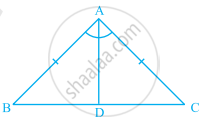
- The sides opposite to equal angles of a triangle are equal.
- If the measures of all angles are different, then all sides are different.
- If the measures of two angles are equal, then the two sides are equal.
- If the measures of three angles are equal, then the three sides are equal, and each angle measures 60˚.
Notes
Angle Sum Property of a Triangle:
There is a remarkable property connecting the three angles of a triangle.
- Draw a triangle. Cut on the three angles. Rearrange them as shown in the following Figure. The three angles now constitute one angle. This angle is a straight angle and so has measure 180°.
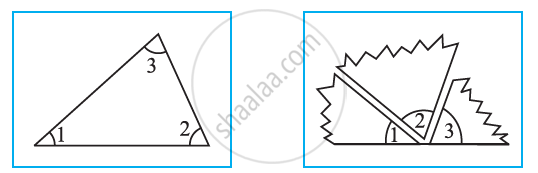
Thus, the sum of the measures of the three angles of a triangle is 180°.
∴ ∠1 + ∠2 + ∠3 = 180°
- Take a piece of paper and cut out a triangle, say, ∆ABC.
Make the altitude AM by folding ∆ABC such that it passes through A.
Fold now the three corners such that all the three vertices A, B, and C touch at M.
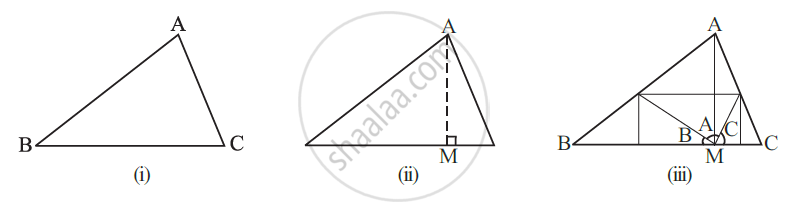
You find that all the three angles form together a straight angle. This again shows that the sum of the measures of the three angles of a triangle is 180°.
∴ ∠B + ∠A + ∠C = 180°
Notes
Property of the lengths of sides of a triangle:
1. Sum of the lengths of two sides of a triangle:
The sum of the lengths of any two sides of a triangle is greater than the length of the third side.
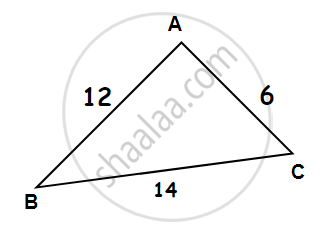
In the above triangle,
6 + 12 = 18 > 14
12 + 14 = 26 > 6
6 + 14 = 20 > 12
2. Difference between lengths of two sides of a triangle:
The difference between the lengths of any two sides is smaller than the length of the third side.
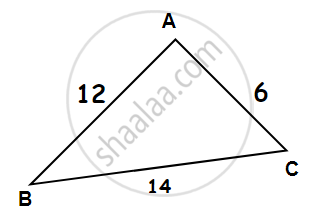
In the above triangle,
12 – 6 = 6 < 14
14 – 12 = 2 < 6
14 – 6 = 8 < 12.
Activity 1
Folding a Triangle
Steps:
- Take a triangular piece of paper.
- Mark corners A, B, and C with different colours or symbols.
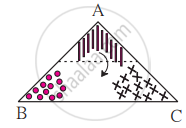
- Fold the triangle from the midpoints of two sides toward the third corner.
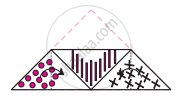
Observation:
When folded, the angles at A, B, and C come together and form a straight line.
Conclusion:
The sum of all three angles in a triangle is 180°.
∠A + ∠B + ∠C = 180°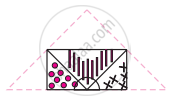
Theorem
Angle Sum Property of a Triangle:
Theorem: The sum of the angles of a triangle is 180°.
Construction: Draw a line XPY parallel to QR through the opposite vertex P.
Proof:
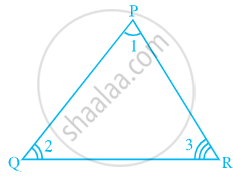
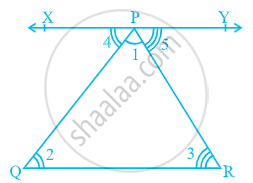
In △ PQR,
Sum of all angles of a triangle is 180°.
∠PQR + ∠PRQ + ∠QPR = 180°......(1)
Since XY is a straight line, it can be concluded that:
Therefore, ∠XPY + ∠QRP + ∠RPY = 180°.
But XPY || QR and PQ, PR are transversals.
So,
∠XPY = ∠PQR.....(Pairs of alternate angles)
∠RPY = ∠PRQ.....(Pairs of alternate angles)
Substituting ∠XPY and ∠RPY in (1), we get
∠PQR + ∠PRQ + ∠QPR = 180°
Thus, The sum of the angles of a triangle is 180°.
Example
Is there a triangle whose sides have lengths 10.2 cm, 5.8 cm, and 4.5 cm?
Suppose such a triangle is possible.
Then the sum of the lengths of any two sides would be greater than the length of the third side.
4.5 + 5.8 >10.2
5.8 + 10.2 > 4.5
10.2 + 4.5 > 5.8
Therefore, the triangle is possible.
Example
The lengths of two sides of a triangle are 6 cm and 8 cm. Between which two numbers can the length of the third side fall?
We know that the sum of two sides of a triangle is always greater than the third.
Therefore, the third side has to be less than the sum of the two sides. The third side is thus,less than 8 + 6 = 14 cm.
The side cannot be less than the difference between the two sides. Thus, the third side has to be more than 8 – 6 = 2 cm.
The length of the third side could be any length greater than 2 and less than 14 cm.
Activity 2
Cutting and Rearranging Angles:
Steps:
- Take a triangle and mark its three corners (angles).
- Draw lines from each corner to a point near the centre.
- Cut along those lines and separate the three angles.
- Arrange the three angles side by side.
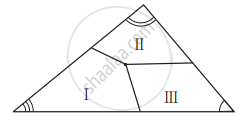
Observation:
When placed together, the three angles form a straight angle (a line).
Conclusion:
The three angles of a triangle always add up to form a straight angle → A straight angle = 180°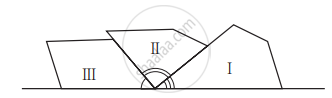
Example
In the given figure find m∠P.
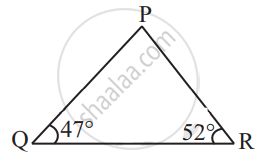
By angle sum property of a triangle,
m∠P + 47° + 52° = 180°
Therefore,
m∠P = 180° – 47° – 52°
m∠P = 180° – 99°
m∠P = 81°