Advertisements
Advertisements
Question
Is it possible to construct a triangle with lengths of its sides as 8 cm, 7 cm and 4 cm? Give reason for your answer.
Advertisements
Solution
Yes, because in each case the sum of two sides is greater than the third side.
i.e., 7 + 4 > 8, 8 + 4 > 7, 7 + 8 > 4
Hence, it is possible to construct a triangle with given sides.
APPEARS IN
RELATED QUESTIONS
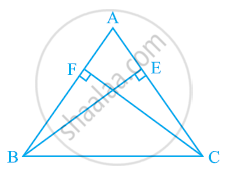
ABC is a triangle in which altitudes BE and CF to sides AC and AB are equal (see the given figure). Show that
- ΔABE ≅ ΔACF
- AB = AC, i.e., ABC is an isosceles triangle.
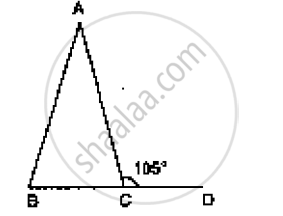
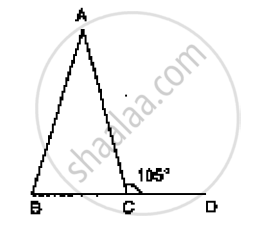
In Figure AB = AC and ∠ACD =105°, find ∠BAC.
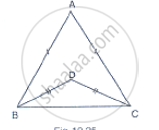
In figure, AB = AC and DB = DC, find the ratio ∠ABD : ∠ACD
Two lines AB and CD intersect at O such that BC is equal and parallel to AD. Prove that the lines AB and CD bisect at O.
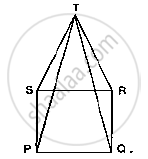
In Fig. 10.23, PQRS is a square and SRT is an equilateral triangle. Prove that
(i) PT = QT (ii) ∠TQR = 15°
In a ΔABC, if AB = AC and ∠B = 70°, find ∠A.
In Figure 10.24, AB = AC and ∠ACD =105°, find ∠BAC.
In a ΔABC, it is given that AB = AC and the bisectors of ∠B and ∠C intersect at O. If M is a point on BO produced, prove that ∠MOC = ∠ABC.
ABC is a triangle in which BE and CF are, respectively, the perpendiculars to the sides AC and AB. If BE = CF, prove that ΔABC is isosceles
Fill the blank in the following so that the following statement is true.
Angle opposite to equal sides of a triangle are .....
Prove that the perimeter of a triangle is greater than the sum of its altitudes.
Fill in the blank to make the following statement true.
The sum of three altitudes of a triangle is ..... than its perimeter.
ABC is a triangle. The bisector of the exterior angle at B and the bisector of ∠C intersect each other at D. Prove that ∠D = \[\frac{1}{2}\] ∠A.
If the angles A, B and C of ΔABC satisfy the relation B − A = C − B, then find the measure of ∠B.
In ΔABC, if ∠A = 100°, AD bisects ∠A and AD ⊥ BC. Then, ∠B =
In ∆ABC, BC = AB and ∠B = 80°. Then ∠A is equal to ______.
Is it possible to construct a triangle with lengths of its sides as 9 cm, 7 cm and 17 cm? Give reason for your answer.
Bisectors of the angles B and C of an isosceles triangle ABC with AB = AC intersect each other at O. Show that external angle adjacent to ∠ABC is equal to ∠BOC
