Advertisements
Advertisements
Question
Show that the angles of an equilateral triangle are 60° each.
Advertisements
Solution
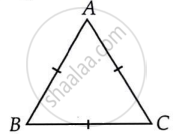
Let ABC be an equilateral triangle.
∴ AB = BC = AC …(A)
AB = BC ...[Taking first and second terms]
⇒ ∠C = ∠A …(i) ...[Angles opposite to equal sides]
Therefore,
AB = AC ...[Taking first and third terms of (A)]
⇒ ∠C = ∠B …(ii) ...[Angles opposite to equal sides]
From (i) and (ii) we get
∠A = ∠B = ∠C …(iii)
Now in △ABC …(iv)
∠A + ∠B + ∠C = 180° ...[Angle Sum Property]
⇒ ∠A + ∠A + ∠A = 180°
⇒ 3∠A = 180
⇒ ∠A = 60°
From (iii), ∠A = ∠B = ∠C
⇒ ∠A = ∠B = ∠C = 60°
Hence, each angle of an equilateral triangle is 60°.
RELATED QUESTIONS
In ΔABC, AD is the perpendicular bisector of BC (see the given figure). Show that ΔABC is an isosceles triangle in which AB = AC.

In figure, AB = AC and DB = DC, find the ratio ∠ABD : ∠ACD
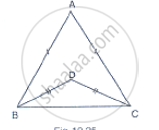
AB is a line seg P and Q are points on opposite sides of AB such that each of them is equidistant from the points A and B (See Fig. 10.26). Show that the line PQ is perpendicular bisector of AB.
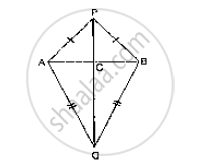
Two lines AB and CD intersect at O such that BC is equal and parallel to AD. Prove that the lines AB and CD bisect at O.
BD and CE are bisectors of ∠B and ∠C of an isosceles ΔABC with AB = AC. Prove that BD = CE.
In an isosceles triangle, if the vertex angle is twice the sum of the base angles, calculate the angles of the triangle.
In a ΔPQR, if PQ = QR and L, M and N are the mid-points of the sides PQ, QR and RP
respectively. Prove that LN = MN.
Fill the blank in the following so that the following statement is true.
In right triangles ABC and DEF, if hypotenuse AB = EF and side AC = DE, then ΔABC ≅ Δ ……
In ΔABC, side AB is produced to D so that BD = BC. If ∠B = 60° and ∠A = 70°, prove that: (i) AD > CD (ii) AD > AC
Which of the following statements are true (T) and which are false (F)?
If two angles of a triangle are unequal, then the greater angle has the larger side opposite to it.
ABC is a triangle. The bisector of the exterior angle at B and the bisector of ∠C intersect each other at D. Prove that ∠D = \[\frac{1}{2}\] ∠A.
If the angles of a triangle are in the ratio 2 : 1 : 3, then find the measure of smallest angle.
In ΔABC, if ∠A = 100°, AD bisects ∠A and AD ⊥ BC. Then, ∠B =
Line segments AB and CD intersect at O such that AC || DB. If ∠CAB = 45° and ∠CDB = 55°, then ∠BOD =
If the measures of angles of a triangle are in the ratio of 3 : 4 : 5, what is the measure of the smallest angle of the triangle?
In the given figure, the value of x is ______.
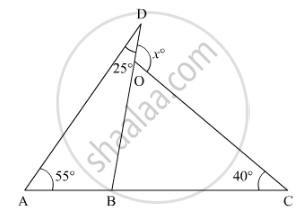
The base BC of triangle ABC is produced both ways and the measure of exterior angles formed are 94° and 126°. Then, ∠BAC =
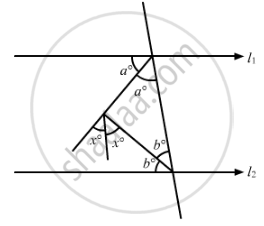
In the given figure, if l1 || l2, the value of x is
Which of the following correctly describes the given triangle?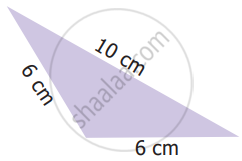
In ∆PQR, ∠R = ∠P and QR = 4 cm and PR = 5 cm. Then the length of PQ is ______.
