Advertisements
Advertisements
Question
In ΔABC, if ∠A = 100°, AD bisects ∠A and AD ⊥ BC. Then, ∠B =
Options
50°
90°
40°
100°
Advertisements
Solution
In the given ΔABC, ∠A= 100°, AD bisects ∠Aand AD ⊥ BC.
Here, we need to find ∠B.
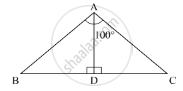
As, AD bisects∠A,
We get,
∠BAD = ∠DAC
100 = 2∠BAD
∠BAD = 50°
Now, according to angle sum property of the triangle
In ΔABD
∠A + ∠B + ∠D = 180°
50° + ∠B + 90° = 180°
140° + ∠B = 180°
∠B = 180° - 140°
= 40°
Hence, ∠B = 40°
APPEARS IN
RELATED QUESTIONS
ABC is an isosceles triangle in which altitudes BE and CF are drawn to equal sides AC and AB respectively (see the given figure). Show that these altitudes are equal.

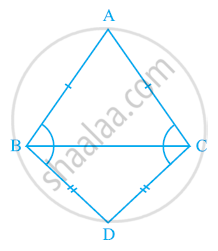
ABC and DBC are two isosceles triangles on the same base BC (see the given figure). Show that ∠ABD = ∠ACD.
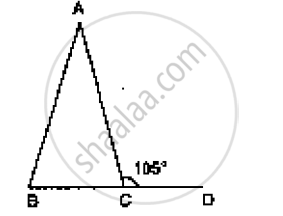
In Figure AB = AC and ∠ACD =105°, find ∠BAC.
If the bisector of the exterior vertical angle of a triangle be parallel to the base. Show that the triangle is isosceles.
Which of the following statements are true (T) and which are false (F):
Sides opposite to equal angles of a triangle may be unequal
Fill in the blank to make the following statement true.
The sum of three altitudes of a triangle is ..... than its perimeter.
Fill in the blank to make the following statement true.
Difference of any two sides of a triangle is........ than the third side.
ABC is a triangle. The bisector of the exterior angle at B and the bisector of ∠C intersect each other at D. Prove that ∠D = \[\frac{1}{2}\] ∠A.
Write the sum of the angles of an obtuse triangle.
In a ΔABC, if ∠A = 60°, ∠B = 80° and the bisectors of ∠B and ∠C meet at O, then ∠BOC =
In the given figure, if EC || AB, ∠ECD = 70° and ∠BDO = 20°, then ∠OBD is
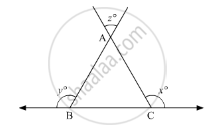
In the given figure, x + y =
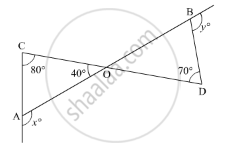
In the given figure, what is z in terms of x and y?
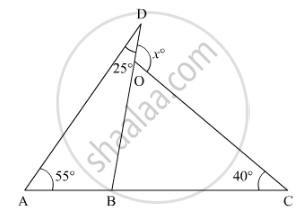
In the given figure, the value of x is ______.
In a ΔABC, ∠A = 50° and BC is produced to a point D. If the bisectors of ∠ABC and ∠ACDmeet at E, then ∠E =
In ∆PQR, ∠R = ∠P and QR = 4 cm and PR = 5 cm. Then the length of PQ is ______.
It is given that ∆ABC ≅ ∆FDE and AB = 5 cm, ∠B = 40° and ∠A = 80°. Then which of the following is true?
In triangles ABC and PQR, AB = AC, ∠C = ∠P and ∠B = ∠Q. The two triangles are ______.
If ∆PQR ≅ ∆EDF, then is it true to say that PR = EF? Give reason for your answer
