Advertisements
Advertisements
Question
Which of the following statements are true (T) and which are false (F):
Angles opposite to equal sides of a triangle are equal
Advertisements
Solution
True (F)
Reason: Since the sides are equal, the corresponding opposite angles must be equal
APPEARS IN
RELATED QUESTIONS
In an isosceles triangle ABC, with AB = AC, the bisectors of ∠B and ∠C intersect each other at O. Join A to O. Show that:
- OB = OC
- AO bisects ∠A
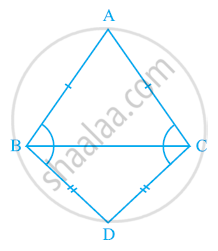
ABC and DBC are two isosceles triangles on the same base BC (see the given figure). Show that ∠ABD = ∠ACD.
In a ΔABC, if ∠A=l20° and AB = AC. Find ∠B and ∠C.
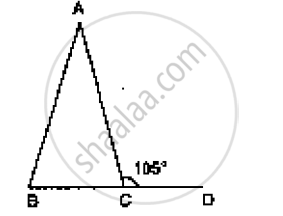
In Figure AB = AC and ∠ACD =105°, find ∠BAC.
Determine the measure of each of the equal angles of a right-angled isosceles triangle.
If the bisector of the exterior vertical angle of a triangle be parallel to the base. Show that the triangle is isosceles.
Angles A, B, C of a triangle ABC are equal to each other. Prove that ΔABC is equilateral.
ABC is a triangle in which BE and CF are, respectively, the perpendiculars to the sides AC and AB. If BE = CF, prove that ΔABC is isosceles
Is it possible to draw a triangle with sides of length 2 cm, 3 cm and 7 cm?
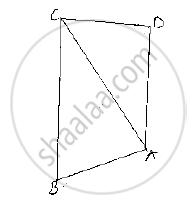
In Fig. 10.131, prove that: (i) CD + DA + AB + BC > 2AC (ii) CD + DA + AB > BC
Fill in the blank to make the following statement true.
If two angles of a triangle are unequal, then the smaller angle has the........ side opposite to it.
Write the sum of the angles of an obtuse triangle.
Line segments AB and CD intersect at O such that AC || DB. If ∠CAB = 45° and ∠CDB = 55°, then ∠BOD =
In the given figure, x + y =
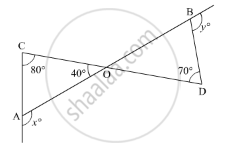
In the given figure, what is y in terms of x?
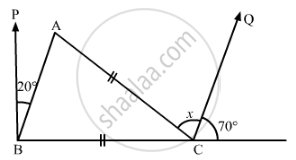
In the given figure, if BP || CQ and AC = BC, then the measure of x is
If the bisectors of the acute angles of a right triangle meet at O, then the angle at Obetween the two bisectors is
Which of the following correctly describes the given triangle?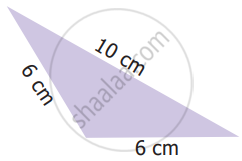
In ∆PQR, ∠P = 70° and ∠R = 30°. Which side of this triangle is the longest? Give reason for your answer.
Find all the angles of an equilateral triangle.
