Advertisements
Advertisements
प्रश्न
Which of the following statements are true (T) and which are false (F):
Angles opposite to equal sides of a triangle are equal
Advertisements
उत्तर
True (F)
Reason: Since the sides are equal, the corresponding opposite angles must be equal
APPEARS IN
संबंधित प्रश्न
Show that the angles of an equilateral triangle are 60° each.
Prove that the medians of an equilateral triangle are equal.
Find the measure of each exterior angle of an equilateral triangle.
P is a point on the bisector of an angle ∠ABC. If the line through P parallel to AB meets BC at Q, prove that triangle BPQ is isosceles.
Which of the following statements are true (T) and which are false (F):
The measure of each angle of an equilateral triangle is 60°
Fill the blank in the following so that the following statement is true.
Angle opposite to equal sides of a triangle are .....
In Fig. 10.131, prove that: (i) CD + DA + AB + BC > 2AC (ii) CD + DA + AB > BC
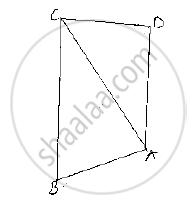
Which of the following statements are true (T) and which are false (F)?
Of all the line segments that can be drawn from a point to a line not containing it, the perpendicular line segment is the shortest one.
Fill in the blank to make the following statement true.
Difference of any two sides of a triangle is........ than the third side.
Fill in the blank to make the following statement true.
If two sides of a triangle are unequal, then the larger side has .... angle opposite to it.
In the given figure, if AB || DE and BD || FG such that ∠FGH = 125° and ∠B = 55°, find x and y.
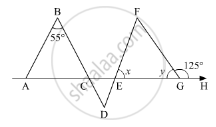
If the angles A, B and C of ΔABC satisfy the relation B − A = C − B, then find the measure of ∠B.
In ΔABC, if ∠A = 100°, AD bisects ∠A and AD ⊥ BC. Then, ∠B =
In the given figure, what is z in terms of x and y?
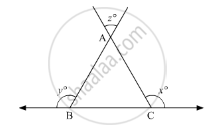
In the given figure, for which value of x is l1 || l2?
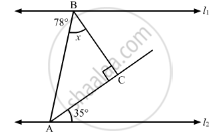
In the given figure, the value of x is ______.
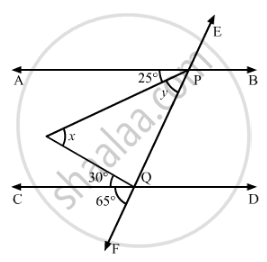
In the given figure, AB and CD are parallel lines and transversal EF intersects them at Pand Q respectively. If ∠APR = 25°, ∠RQC = 30° and ∠CQF = 65°, then
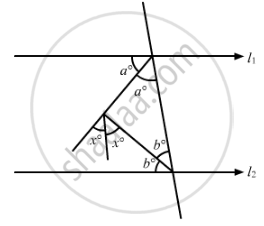
In the given figure, if l1 || l2, the value of x is
If ∆PQR ≅ ∆EDF, then is it true to say that PR = EF? Give reason for your answer
