Advertisements
Advertisements
Question
Fill the blank in the following so that the following statement is true.
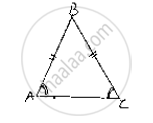
In a ΔABC if ∠A = ∠C , then AB = ......
Advertisements
Solution
In a ΔABC if , ∠A= ∠C then AB= BC
Reason: Since, the sides opposite to equal angles are equal, the side opposite to∠A
i.e., BC and ∠C i.e., AB are equal
APPEARS IN
RELATED QUESTIONS
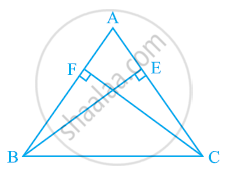
ABC is a triangle in which altitudes BE and CF to sides AC and AB are equal (see the given figure). Show that
- ΔABE ≅ ΔACF
- AB = AC, i.e., ABC is an isosceles triangle.
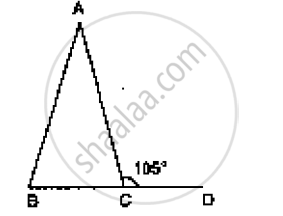
In Figure AB = AC and ∠ACD =105°, find ∠BAC.
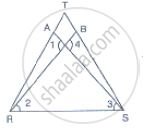
In Fig. 10.40, it is given that RT = TS, ∠1 = 2∠2 and ∠4 = 2∠3. Prove that ΔRBT ≅ ΔSAT
Angles A, B, C of a triangle ABC are equal to each other. Prove that ΔABC is equilateral.
ABC is a right angled triangle in which ∠A = 90° and AB = AC. Find ∠B and ∠C.
ABC is a triangle and D is the mid-point of BC. The perpendiculars from D to AB and AC are equal. Prove that the triangle is isosceles.
In Fig. 10.131, prove that: (i) CD + DA + AB + BC > 2AC (ii) CD + DA + AB > BC
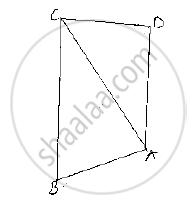
Which of the following statements are true (T) and which are false (F)?
Difference of any two sides of a triangle is equal to the third side.
Fill in the blank to make the following statement true.
The sum of three altitudes of a triangle is ..... than its perimeter.
Fill in the blank to make the following statement true.
Difference of any two sides of a triangle is........ than the third side.
Write the sum of the angles of an obtuse triangle.
If the angles A, B and C of ΔABC satisfy the relation B − A = C − B, then find the measure of ∠B.
If the measures of angles of a triangle are in the ratio of 3 : 4 : 5, what is the measure of the smallest angle of the triangle?
In the given figure, if AB ⊥ BC. then x =
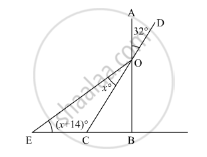
In the given figure, what is the value of x?
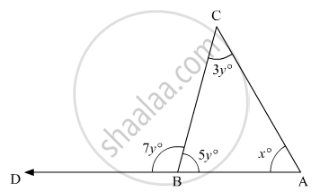
In the given figure, if BP || CQ and AC = BC, then the measure of x is
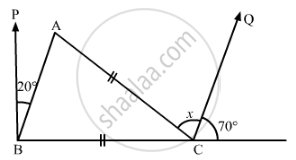
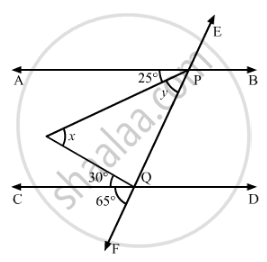
In the given figure, AB and CD are parallel lines and transversal EF intersects them at Pand Q respectively. If ∠APR = 25°, ∠RQC = 30° and ∠CQF = 65°, then
In ∆ABC, BC = AB and ∠B = 80°. Then ∠A is equal to ______.
CDE is an equilateral triangle formed on a side CD of a square ABCD (Figure). Show that ∆ADE ≅ ∆BCE.

