Advertisements
Advertisements
Question
In triangles ABC and PQR, AB = AC, ∠C = ∠P and ∠B = ∠Q. The two triangles are ______.
Options
isosceles but not congruent
isosceles and congruent
congruent but not isosceles
neither congruent nor isosceles
Advertisements
Solution
In triangles ABC and PQR, AB = AC, ∠C = ∠P and ∠B = ∠Q. The two triangles are isosceles but not congruent.
Explanation:
In triangle ABC,
AB = AC ...[Given]
∠C = ∠B ...[Angle opposite to equal sides are equal]
So, in triangle ABC is an isosceles triangle.
∠B = ∠Q ...[Given]
∠C = ∠P
∠P = ∠Q ...[Since, ∠C = ∠B]
QR = PR ...[Sides opposite to equal angles are equal]
So, in triangle PQR is also an isosceles triangle.
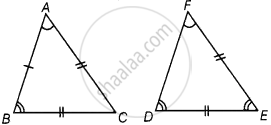
Hence, both triangle are isosceles but not congruent.
APPEARS IN
RELATED QUESTIONS
In ΔABC, AD is the perpendicular bisector of BC (see the given figure). Show that ΔABC is an isosceles triangle in which AB = AC.

ABC is an isosceles triangle in which altitudes BE and CF are drawn to equal sides AC and AB respectively (see the given figure). Show that these altitudes are equal.

ABC and DBC are two isosceles triangles on the same base BC (see the given figure). Show that ∠ABD = ∠ACD.
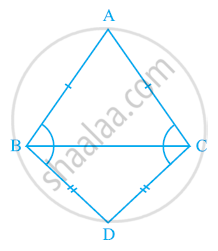
ΔABC is an isosceles triangle in which AB = AC. Side BA is produced to D such that AD = AB (see the given figure). Show that ∠BCD is a right angle.

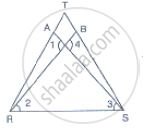
In Fig. 10.40, it is given that RT = TS, ∠1 = 2∠2 and ∠4 = 2∠3. Prove that ΔRBT ≅ ΔSAT
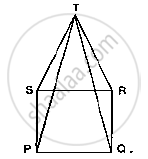
In Fig. 10.23, PQRS is a square and SRT is an equilateral triangle. Prove that
(i) PT = QT (ii) ∠TQR = 15°
Prove that the medians of an equilateral triangle are equal.
In a ΔABC, if AB = AC and ∠B = 70°, find ∠A.
ABC is a triangle in which BE and CF are, respectively, the perpendiculars to the sides AC and AB. If BE = CF, prove that ΔABC is isosceles
Which of the following statements are true (T) and which are false (F):
Sides opposite to equal angles of a triangle may be unequal
Which of the following statements are true (T) and which are false (F):
Angles opposite to equal sides of a triangle are equal
In a triangle ABC, if AB = AC and AB is produced to D such that BD = BC, find ∠ACD: ∠ADC.
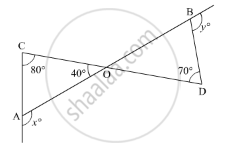
In the given figure, x + y =
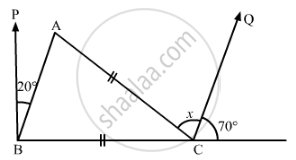
In the given figure, if BP || CQ and AC = BC, then the measure of x is
The base BC of triangle ABC is produced both ways and the measure of exterior angles formed are 94° and 126°. Then, ∠BAC =
In a ΔABC, ∠A = 50° and BC is produced to a point D. If the bisectors of ∠ABC and ∠ACDmeet at E, then ∠E =
Which of the following correctly describes the given triangle?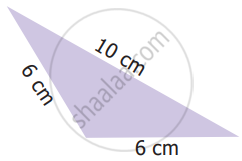
In the following figure, D and E are points on side BC of a ∆ABC such that BD = CE and AD = AE. Show that ∆ABD ≅ ∆ACE.

CDE is an equilateral triangle formed on a side CD of a square ABCD (Figure). Show that ∆ADE ≅ ∆BCE.

Show that in a quadrilateral ABCD, AB + BC + CD + DA < 2(BD + AC)
