Advertisements
Advertisements
प्रश्न
In triangles ABC and PQR, AB = AC, ∠C = ∠P and ∠B = ∠Q. The two triangles are ______.
पर्याय
isosceles but not congruent
isosceles and congruent
congruent but not isosceles
neither congruent nor isosceles
Advertisements
उत्तर
In triangles ABC and PQR, AB = AC, ∠C = ∠P and ∠B = ∠Q. The two triangles are isosceles but not congruent.
Explanation:
In triangle ABC,
AB = AC ...[Given]
∠C = ∠B ...[Angle opposite to equal sides are equal]
So, in triangle ABC is an isosceles triangle.
∠B = ∠Q ...[Given]
∠C = ∠P
∠P = ∠Q ...[Since, ∠C = ∠B]
QR = PR ...[Sides opposite to equal angles are equal]
So, in triangle PQR is also an isosceles triangle.
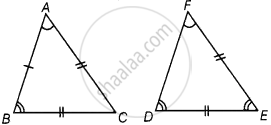
Hence, both triangle are isosceles but not congruent.
APPEARS IN
संबंधित प्रश्न
In an isosceles triangle ABC, with AB = AC, the bisectors of ∠B and ∠C intersect each other at O. Join A to O. Show that:
- OB = OC
- AO bisects ∠A
In ΔABC, AD is the perpendicular bisector of BC (see the given figure). Show that ΔABC is an isosceles triangle in which AB = AC.

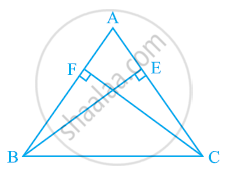
ABC is a triangle in which altitudes BE and CF to sides AC and AB are equal (see the given figure). Show that
- ΔABE ≅ ΔACF
- AB = AC, i.e., ABC is an isosceles triangle.
ΔABC is an isosceles triangle in which AB = AC. Side BA is produced to D such that AD = AB (see the given figure). Show that ∠BCD is a right angle.

In a ΔABC, if ∠A=l20° and AB = AC. Find ∠B and ∠C.
If the base of an isosceles triangle is produced on both sides, prove that the exterior angles so formed are equal to each other.
BD and CE are bisectors of ∠B and ∠C of an isosceles ΔABC with AB = AC. Prove that BD = CE.
ABC is a triangle and D is the mid-point of BC. The perpendiculars from D to AB and AC are equal. Prove that the triangle is isosceles.
Which of the following statements are true (T) and which are false (F):
Angles opposite to equal sides of a triangle are equal
O is any point in the interior of ΔABC. Prove that
(i) AB + AC > OB + OC
(ii) AB + BC + CA > OA + QB + OC
(iii) OA + OB + OC >` 1/2`(AB + BC + CA)
Prove that the perimeter of a triangle is greater than the sum of its altitudes.
Which of the following statements are true (T) and which are false (F)?
Sum of any two sides of a triangle is greater than the third side.
ABC is a triangle. The bisector of the exterior angle at B and the bisector of ∠C intersect each other at D. Prove that ∠D = \[\frac{1}{2}\] ∠A.
Line segments AB and CD intersect at O such that AC || DB. If ∠CAB = 45° and ∠CDB = 55°, then ∠BOD =
In the given figure, if EC || AB, ∠ECD = 70° and ∠BDO = 20°, then ∠OBD is
In the given figure, if AB ⊥ BC. then x =
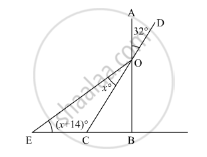
In the given figure, the value of x is ______.
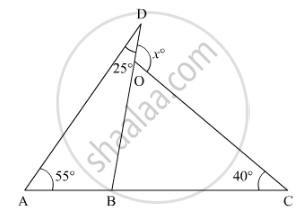
The angles of a right angled triangle are
Is it possible to construct a triangle with lengths of its sides as 9 cm, 7 cm and 17 cm? Give reason for your answer.
