Advertisements
Advertisements
प्रश्न
ABC is an isosceles triangle with AB = AC and D is a point on BC such that AD ⊥ BC (Figure). To prove that ∠BAD = ∠CAD, a student proceeded as follows:
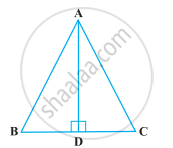
In ∆ABD and ∆ACD,
AB = AC (Given)
∠B = ∠C (Because AB = AC)
and ∠ADB = ∠ADC
Therefore, ∆ABD ≅ ∆ACD (AAS)
So, ∠BAD = ∠CAD (CPCT)
What is the defect in the above arguments?
[Hint: Recall how ∠B = ∠C is proved when AB = AC].
Advertisements
उत्तर
In ∆ABC, AB = AC
⇒ ∠ACB = ∠ABC ...[Angles opposite to the equal sides are equal]
In ∆ABD and ∆ACD,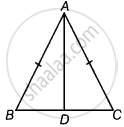
AB = AC ...[Given]
∠ABD = ∠ACD ...[Proved above]
∠ADB = ∠ADC ...[Each 90°]
∴ ∆ABD ≅ ∆ACD ...[By AAS]
So, ∠BAD = ∠CAD ...[By CPCT]
So, the defect in the given argument is that firstly prove ∠ABD = ∠ACD
Hence, ∠ABD = ∠ACD is defect.
APPEARS IN
संबंधित प्रश्न
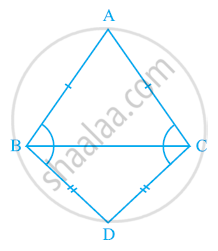
ABC and DBC are two isosceles triangles on the same base BC (see the given figure). Show that ∠ABD = ∠ACD.
In a ΔABC, if AB = AC and ∠B = 70°, find ∠A.
Prove that each angle of an equilateral triangle is 60°.
ABC is a triangle in which ∠B = 2 ∠C. D is a point on BC such that AD bisects ∠BAC and AB = CD.
Prove that ∠BAC = 72°.
Fill the blank in the following so that the following statement is true.
Angle opposite to equal sides of a triangle are .....
Which of the following statements are true (T) and which are false (F)?
Sum of the three sides of a triangle is less than the sum of its three altitudes.
Fill in the blank to make the following statement true.
The sum of any two sides of a triangle is .... than the third side.
Fill in the blank to make the following statement true.
Difference of any two sides of a triangle is........ than the third side.
In the given figure, the sides BC, CA and AB of a Δ ABC have been produced to D, E and F respectively. If ∠ACD = 105° and ∠EAF = 45°, find all the angles of the Δ ABC.
Write the sum of the angles of an obtuse triangle.
In the given figure, if AB || DE and BD || FG such that ∠FGH = 125° and ∠B = 55°, find x and y.
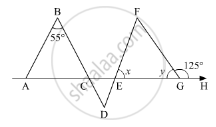
In the given figure, x + y =
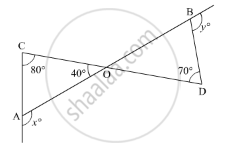
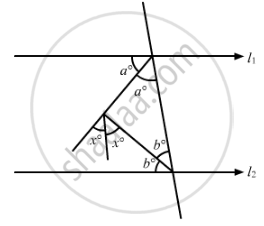
In the given figure, for which value of x is l1 || l2?
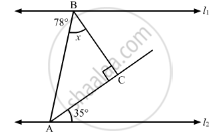
In the given figure, the value of x is ______.
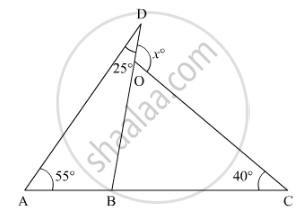
In the given figure, AB and CD are parallel lines and transversal EF intersects them at Pand Q respectively. If ∠APR = 25°, ∠RQC = 30° and ∠CQF = 65°, then
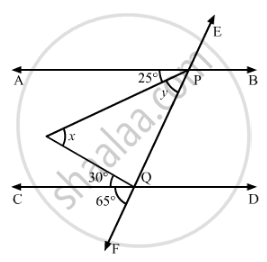
If the bisectors of the acute angles of a right triangle meet at O, then the angle at Obetween the two bisectors is
In a ΔABC, ∠A = 50° and BC is produced to a point D. If the bisectors of ∠ABC and ∠ACDmeet at E, then ∠E =
In the given figure, if l1 || l2, the value of x is
It is given that ∆ABC ≅ ∆FDE and AB = 5 cm, ∠B = 40° and ∠A = 80°. Then which of the following is true?
