Advertisements
Advertisements
प्रश्न
O is any point in the interior of ΔABC. Prove that
(i) AB + AC > OB + OC
(ii) AB + BC + CA > OA + QB + OC
(iii) OA + OB + OC >` 1/2`(AB + BC + CA)
Advertisements
उत्तर
Given that O is any point in the interior of ABC
We have to prove
(i) AB + AC > OB + OC
(ii) AB + BC + CA > OA + QB + OC
(iii) OA + OB + OC >`1/2`(AB + BC + CA)
We know that, in a triangle the sum of any two sides is greater than the third side So, we have
In ΔABC
AB+BC>AC
BC+AC>AB
AC+AB>BC
In ΔOBC
OB+OC>BC ...........(1)
In ΔOAC
OA+OC>AC ...........(2)
In ΔOAB
OA+OB>AB ............(3)
Now, extend (or) produce BO to meet AC in D.
Now, in ΔABD,we have
AB+AD+BD
⇒ AB+AD>BO+OD .............(4) [∵ BD=BO+OD]
Similarly in , ΔODC we have
OD+DC>OC ...............(5)
(1) Adding (4) and (5), we get
AB+AD+OD+DC>BO+OD+OC
⇒AB+(AD+DC)>OB+OC
⇒ AB+AC>OB+OC ...............(6)
Similarly, we have
BC+BA>OA+OC ...............(7)
and CA+CB>OA+OB ..............(8)
(2) Adding equation (6), (7) and (8), we get
AB+AC+BC+BA+CA+CB>OB+OC+OA+OC+OA+OB
⇒2AB+2BC+CA>2OA+2OB+2OC
⇒2(AB+BC+CA>OA+OB+OC)
⇒AB+BC+CA>OA+OB+OC
(3) Adding equations (1), (2) and (3)
OB+OC+OA+OC+OA+OB+>BC+AC+AB
⇒2OA+2OB+2OC>AB+BC+CA
We get⇒ 2(OA+OB+OC)>AB+BC+CA
∴ (OA+OB+OC)>`1/2`(AB+BC+CA)
APPEARS IN
संबंधित प्रश्न
In an isosceles triangle ABC, with AB = AC, the bisectors of ∠B and ∠C intersect each other at O. Join A to O. Show that:
- OB = OC
- AO bisects ∠A
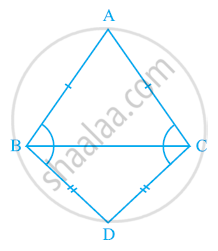
ABC and DBC are two isosceles triangles on the same base BC (see the given figure). Show that ∠ABD = ∠ACD.
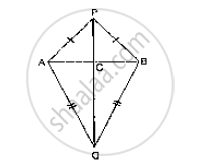
AB is a line seg P and Q are points on opposite sides of AB such that each of them is equidistant from the points A and B (See Fig. 10.26). Show that the line PQ is perpendicular bisector of AB.
In a ΔABC, if ∠A=l20° and AB = AC. Find ∠B and ∠C.
Find the measure of each exterior angle of an equilateral triangle.
BD and CE are bisectors of ∠B and ∠C of an isosceles ΔABC with AB = AC. Prove that BD = CE.
If the bisector of the exterior vertical angle of a triangle be parallel to the base. Show that the triangle is isosceles.
Angles A, B, C of a triangle ABC are equal to each other. Prove that ΔABC is equilateral.
Fill the blank in the following so that the following statement is true.
Sides opposite to equal angles of a triangle are ......
In a ΔABC, if ∠B = ∠C = 45°, which is the longest side?
In ΔABC, side AB is produced to D so that BD = BC. If ∠B = 60° and ∠A = 70°, prove that: (i) AD > CD (ii) AD > AC
Which of the following statements are true (T) and which are false (F)?
Sum of any two sides of a triangle is greater than the third side.
Which of the following statements are true (T) and which are false (F)?
If two angles of a triangle are unequal, then the greater angle has the larger side opposite to it.
If the angles of a triangle are in the ratio 2 : 1 : 3, then find the measure of smallest angle.
If the angles A, B and C of ΔABC satisfy the relation B − A = C − B, then find the measure of ∠B.
In ΔABC, if ∠A = 100°, AD bisects ∠A and AD ⊥ BC. Then, ∠B =
In the given figure, x + y =
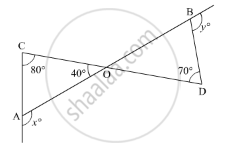
In the given figure, the value of x is ______.
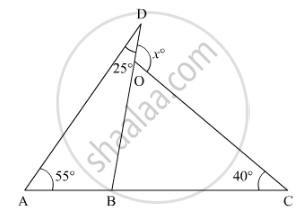
In ∆PQR, ∠R = ∠P and QR = 4 cm and PR = 5 cm. Then the length of PQ is ______.
M is a point on side BC of a triangle ABC such that AM is the bisector of ∠BAC. Is it true to say that perimeter of the triangle is greater than 2 AM? Give reason for your answer.
