In a triangle ABC, D is the mid-point of side AC such that BD = 12 AC. Show that ∠ABC is a right angle.
Advertisements
प्रश्न
In a triangle ABC, D is the mid-point of side AC such that BD = `1/2` AC. Show that ∠ABC is a right angle.
Advertisements
उत्तर
Given: In ΔABC, D is the mid-point of AC i.e., AD = CD such that BD = `1/2` AC.
To show: ∠ABC = 90°
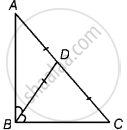
Proof: We have BD = `1/2` AC ...(i)
Since, D is the mid-point of AC.
∴ AD = CD = `1/2` AC ...(ii)
From equations (i) and (ii),
AD = CD = BD
In ΔDAB, AD = BD ...[Proved above]
∴ ∠ABD = ∠BAD ...(iii) [Angles opposite to equal sides are equal]
In ΔDBC, BD = CD ...[Proved above]
∴ ∠BCD = ∠CBD ...(iv) [Angles opposite to equal sides are equal]
In ΔABC, ∠ABC + ∠BAC + ∠ACB = 180° ...[By angle sum property of a triangle]
⇒ ∠ABC + ∠BAD + ∠DCB = 180°
⇒ ∠ABC + ∠ABD + ∠CBD = 180° ...[From equations (iii) and (iv)]
⇒ ∠ABC + ∠ABC = 180°
⇒ 2∠ABC = 180°
⇒ ∠ABC = 90°
APPEARS IN
संबंधित प्रश्न
Determine the measure of each of the equal angles of a right-angled isosceles triangle.
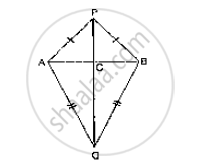
AB is a line seg P and Q are points on opposite sides of AB such that each of them is equidistant from the points A and B (See Fig. 10.26). Show that the line PQ is perpendicular bisector of AB.
In a ΔABC, if AB = AC and ∠B = 70°, find ∠A.
If the bisector of the exterior vertical angle of a triangle be parallel to the base. Show that the triangle is isosceles.
In an isosceles triangle, if the vertex angle is twice the sum of the base angles, calculate the angles of the triangle.
PQR is a triangle in which PQ = PR and S is any point on the side PQ. Through S, a line is drawn parallel to QR and intersecting PR at T. Prove that PS = PT.
Which of the following statements are true (T) and which are false (F):
Sides opposite to equal angles of a triangle may be unequal
Fill the blank in the following so that the following statement is true.
Angle opposite to equal sides of a triangle are .....
Fill the blank in the following so that the following statement is true.
In an equilateral triangle all angles are .....
Fill the blank in the following so that the following statement is true.
If altitudes CE and BF of a triangle ABC are equal, then AB = ....
Write the sum of the angles of an obtuse triangle.
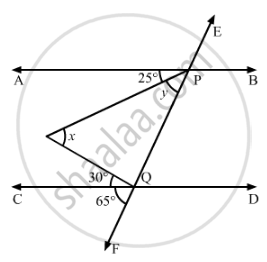
In the given figure, AB and CD are parallel lines and transversal EF intersects them at Pand Q respectively. If ∠APR = 25°, ∠RQC = 30° and ∠CQF = 65°, then
The side BC of ΔABC is produced to a point D. The bisector of ∠A meets side BC in L. If ∠ABC = 30° and ∠ACD = 115°, then ∠ALC = ______.
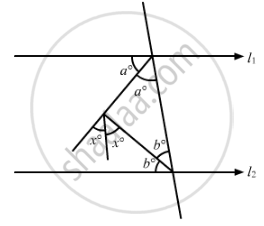
In the given figure, if l1 || l2, the value of x is
In ∆ABC, AB = AC and ∠B = 50°. Then ∠C is equal to ______.
It is given that ∆ABC ≅ ∆FDE and AB = 5 cm, ∠B = 40° and ∠A = 80°. Then which of the following is true?
In the following figure, D and E are points on side BC of a ∆ABC such that BD = CE and AD = AE. Show that ∆ABD ≅ ∆ACE.

CDE is an equilateral triangle formed on a side CD of a square ABCD (Figure). Show that ∆ADE ≅ ∆BCE.

ABC is an isosceles triangle with AB = AC and D is a point on BC such that AD ⊥ BC (Figure). To prove that ∠BAD = ∠CAD, a student proceeded as follows:
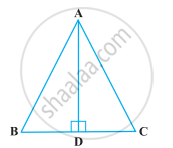
In ∆ABD and ∆ACD,
AB = AC (Given)
∠B = ∠C (Because AB = AC)
and ∠ADB = ∠ADC
Therefore, ∆ABD ≅ ∆ACD (AAS)
So, ∠BAD = ∠CAD (CPCT)
What is the defect in the above arguments?
[Hint: Recall how ∠B = ∠C is proved when AB = AC].
