Advertisements
Advertisements
प्रश्न
In a ΔABC, if ∠A = 60°, ∠B = 80° and the bisectors of ∠B and ∠C meet at O, then ∠BOC =
पर्याय
60°
120°
150°
30°
Advertisements
उत्तर
In the given ΔABC,∠A = 60° and ∠B = 80° . Bisectors of ∠B and ∠C meet at O.
We need to find ∠BOC

Since, OB is the bisector of ∠B.
Thus, `∠OBC = 1/2 ∠ABC ..... (1)`
Now, using the angle sum property of the triangle
In ΔABC, we get,
∠A + ∠B + ∠C =180°
60° + 80° + ∠C = 180°
140° + ∠C = 180°
∠C = 180° - 140°
∠C = 40°
Similarly, in ΔBOC
∠OBC + ∠O + ∠OCB = 180
∠O + 20° + 40°=180°
∠O + 60° = 180°
∠O = 180° - 60°
= 120°
Hence, ∠BOC = 120°
APPEARS IN
संबंधित प्रश्न
ΔABC is an isosceles triangle in which AB = AC. Side BA is produced to D such that AD = AB (see the given figure). Show that ∠BCD is a right angle.

Find the measure of each exterior angle of an equilateral triangle.
Prove that each angle of an equilateral triangle is 60°.
ABC is a right angled triangle in which ∠A = 90° and AB = AC. Find ∠B and ∠C.
Which of the following statements are true (T) and which are false (F):
If the bisector of the vertical angle of a triangle bisects the base, then the triangle may be isosceles.
In Fig. 10.131, prove that: (i) CD + DA + AB + BC > 2AC (ii) CD + DA + AB > BC
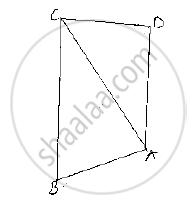
Which of the following statements are true (T) and which are false (F)?
Sum of the three sides of a triangle is less than the sum of its three altitudes.
Which of the following statements are true (T) and which are false (F)?
Sum of any two sides of a triangle is greater than the third side.
Fill in the blank to make the following statement true.
If two angles of a triangle are unequal, then the smaller angle has the........ side opposite to it.
Write the sum of the angles of an obtuse triangle.
In the given figure, if AB ⊥ BC. then x =
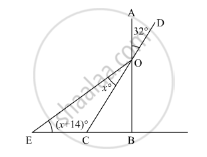
In the given figure, what is z in terms of x and y?
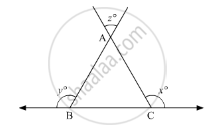
In ∆ABC, BC = AB and ∠B = 80°. Then ∠A is equal to ______.
In ∆PQR, ∠R = ∠P and QR = 4 cm and PR = 5 cm. Then the length of PQ is ______.
D is a point on the side BC of a ∆ABC such that AD bisects ∠BAC. Then ______.
In triangles ABC and PQR, AB = AC, ∠C = ∠P and ∠B = ∠Q. The two triangles are ______.
AD is a median of the triangle ABC. Is it true that AB + BC + CA > 2AD? Give reason for your answer.
ABC is an isosceles triangle with AB = AC and D is a point on BC such that AD ⊥ BC (Figure). To prove that ∠BAD = ∠CAD, a student proceeded as follows:
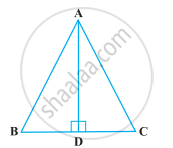
In ∆ABD and ∆ACD,
AB = AC (Given)
∠B = ∠C (Because AB = AC)
and ∠ADB = ∠ADC
Therefore, ∆ABD ≅ ∆ACD (AAS)
So, ∠BAD = ∠CAD (CPCT)
What is the defect in the above arguments?
[Hint: Recall how ∠B = ∠C is proved when AB = AC].
Show that in a quadrilateral ABCD, AB + BC + CD + DA < 2(BD + AC)
Show that in a quadrilateral ABCD, AB + BC + CD + DA > AC + BD
