Advertisements
Advertisements
प्रश्न
In the given figure, x + y =
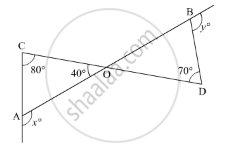
पर्याय
270
230
210
190°
Advertisements
उत्तर
In the given figure, we need to find x+ y
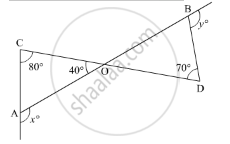
Here, AB and CD are straight lines intersecting at point O, so using the property, “vertically opposite angles are equal”, we get,
∠BOD = ∠AOC
∠BOD = 40°
Further, applying the property, “an exterior angle of a triangle is equal to the sum of the two opposite interior angles”, in ΔAOC, we get,
x° = ∠ACO + ∠AOC
x° = 80° + 40°
x° = 120°
Similarly, in ΔBOD
y° = ∠BOD + ∠BDO
y° = 40° + 70°
y° = 110°
Thus,
x° + y° = 120° + 110°
x° + y° = 230°
APPEARS IN
संबंधित प्रश्न
In a ΔABC, if AB = AC and ∠B = 70°, find ∠A.
Find the measure of each exterior angle of an equilateral triangle.
Two lines AB and CD intersect at O such that BC is equal and parallel to AD. Prove that the lines AB and CD bisect at O.
BD and CE are bisectors of ∠B and ∠C of an isosceles ΔABC with AB = AC. Prove that BD = CE.
In an isosceles triangle, if the vertex angle is twice the sum of the base angles, calculate the angles of the triangle.
Which of the following statements are true (T) and which are false (F):
The bisectors of two equal angles of a triangle are equal
In a ΔABC, if ∠B = ∠C = 45°, which is the longest side?
In ΔABC, side AB is produced to D so that BD = BC. If ∠B = 60° and ∠A = 70°, prove that: (i) AD > CD (ii) AD > AC
O is any point in the interior of ΔABC. Prove that
(i) AB + AC > OB + OC
(ii) AB + BC + CA > OA + QB + OC
(iii) OA + OB + OC >` 1/2`(AB + BC + CA)
Prove that the perimeter of a triangle is greater than the sum of its altitudes.
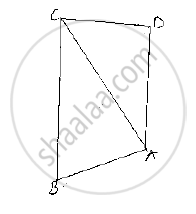
In Fig. 10.131, prove that: (i) CD + DA + AB + BC > 2AC (ii) CD + DA + AB > BC
Fill in the blank to make the following statement true.
In a right triangle the hypotenuse is the .... side.
Fill in the blank to make the following statement true.
The sum of three altitudes of a triangle is ..... than its perimeter.
Fill in the blank to make the following statement true.
The sum of any two sides of a triangle is .... than the third side.
In ΔABC, if ∠A = 100°, AD bisects ∠A and AD ⊥ BC. Then, ∠B =
In the given figure, what is the value of x?
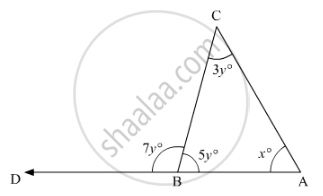
Which of the following correctly describes the given triangle?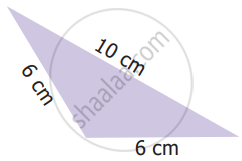
In ∆ABC, BC = AB and ∠B = 80°. Then ∠A is equal to ______.
Is it possible to construct a triangle with lengths of its sides as 9 cm, 7 cm and 17 cm? Give reason for your answer.
